

 Every afternoon, millions of young people leave school and head to camps, libraries, sports fields, arts programs, jobs, youth organizations, faith communities, neighborhoods and homes. But millions do not.
More than 3 in 4 of the children whose parents want them in afterschool programs — 22.6 million — are not enrolled because of cost, lack of availability (waitlists or no programs) or the need for transportation, according to the 2025 America After 3PM Survey conducted by the Afterschool Alliance.

The terms “afterschool,” “summer” or “extracurricular” suggest that these experiences are optional supplements to education. Developmental science tells a different story.
Young people continue to learn, build relationships, discover interests, strengthen identities, develop agency and contribute to their communities long after the school day and school term end. These experiences complement formal academic instruction. But they are foundational to holistic youth development.
The challenge is to recognize these hours, relationships and settings as parts of a single developmental ecosystem — and to align and co-act so young people’s voices, agency and contributions help shape the environments that shape them, creating conditions that enable everyone to thrive.
That theme surfaced repeatedly in my recent conversations with Australian learning scientist Stephanie MacMahon and developmental psychologist Kim Schonert-Reichl on episode 5 of the Thriving Youth Knowledge Exchange podcast. These scholars approach development through different disciplines and work across different countries. Yet they reach a similar conclusion:
Communities either create — or miss — opportunities for young people to continue learning, contributing and thriving throughout the day and year.
 MacMahon is a senior lecturer in the University of Queensland’s School of Education and co-founder and program director of the UQ Learning Lab — a group of multidisciplinary researchers, educators and industry partners who collaborate to transform learning, teaching and training in diverse school and post-school contexts through the science of learning. Whether studying adolescents in Australian schools or adults in Australia’s mining industry, she reaches the same conclusion: People want to master what they do, learn deeply and contribute purposefully. Those experiences create motivation, connection, belonging and meaning. The settings change. The developmental principles remain remarkably consistent.
Schonert-Reichl is a professor of community and applied developmental psychology at the University of Illinois Chicago, where she leads the Social and Emotional Learning Lab. Prior to moving to UIC, she spent nearly three decades as a professor at the University of British Columbia, where she was one of the principal architects of the Middle Years Development Instrument (MDI), one of Canada’s most influential child well-being measurement tools.
[Related: Why unconstrained kids need unconstrained ecosystems]
The MDI reflects the cross-fertilization of ideas among researchers, practitioners and youth development theorists committed to improving practice. It invites communities to look beyond how young people experience school to understand the broader developmental ecosystem in which they learn, build relationships, exercise agency, contribute and thrive.
“In the development of the MDI we were inspired by the work of the Search Institute — and its focus on strengths, positive youth development and relationships,” Schonert-Reichl conveyed in a follow-up communique. “The MDI and Developmental Assets reflect the same fundamental shift — from identifying what is wrong with young people to understanding the relationships, opportunities and strengths they need to thrive across the social fields and life spaces they experience.”
The MDI extends that shared philosophy by asking young people directly about their experiences across the settings, relationships and opportunities that make up their life space. It examines five dimensions that help communities see where developmental opportunities are plentiful, where they are uneven or missing, and where coordinated action could strengthen the broader developmental ecosystem. Two companion tools, the EDI (Early Development Instrument) and the YDI (Youth Development Instrument), allow communities to use this strengths-based approach from early childhood through high school.
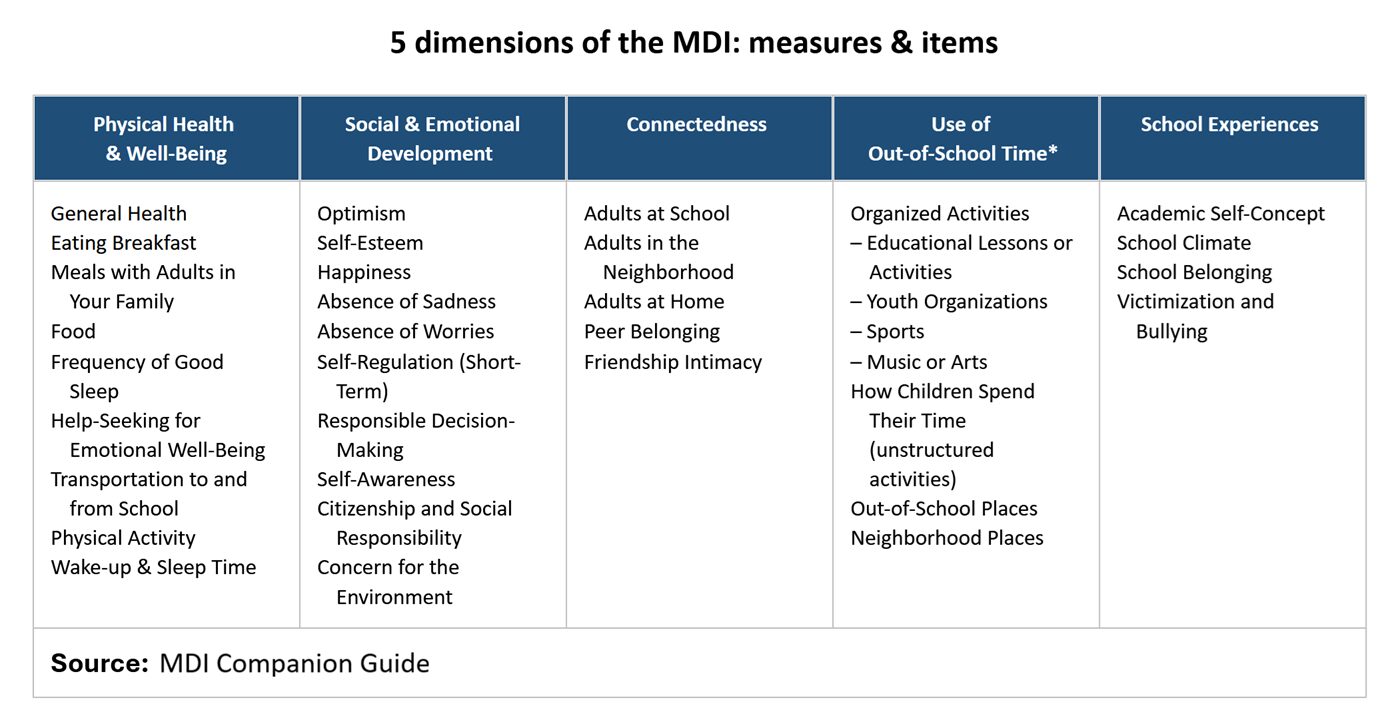
Schonert-Reichl describes how to use MDI data as “a flashlight, not a hammer.” The purpose is not to judge young people, schools or communities. It is to illuminate strengths, disparities and opportunities that communities might otherwise overlook. Before we can strengthen a developmental ecosystem, we have to see it.
One simple question — “What do you wish you could be doing after school?” — helped communities rethink recreation, arts, mentoring, youth leadership and other opportunities beyond the school day.
Adults did more than collect data. They began creating opportunities with young people rather than for them.
Courtesy of David Osher
David Osher, RCC
That distinction matters. Youth voice is not an invitation to comment after adults have made the important decisions. It is one way young people can exercise agency and help shape the environments that shape them. Co-action begins when adults listen seriously, respond thoughtfully and create opportunities for young people to participate in shaping the places where they learn, grow and contribute.
Seen together, MacMahon’s and Schonert-Reichl’s work invites us to ask a different question. Rather than asking whether a particular program works, what if we asked: “What developmental opportunities do young people experience across a day, a week, a summer and a year?”
Schools remain indispensable. But they cannot — and should not — carry the entire responsibility for development. Nor can camps, libraries, youth organizations, employers, recreation departments, faith communities, families or neighborhoods. Each contributes something different. The question is whether those contributions reinforce one another and whether all youth and families find them accessible, affordable and appropriate.
Young people do not move between separate developmental worlds.
Our challenge is to ensure that the adults, organizations and institutions surrounding them do the same.
The work is not to extend school into every hour of childhood. Nor is it to fill every unscheduled hour with another program. It is to strengthen the developmental ecosystem so more young people find places where they belong, people who know them, opportunities to grow and meaningful ways to contribute. And tools like the MDI can ensure that this ecosystem is healthy and equitable.
***
The Thriving Youth Knowledge Exchange: Deeper Learning and Equity podcast series explores how to build the conditions for youth thriving more intentionally, in more places, for more young people. Previous pieces in the series can be read here:
Five shifts that would change everything
What John King’s teachers were actually doing
An invitation to learn, reflect and act together for equity-centered thriving
David Osher has been an organizer, professor, dean of an experimental college and schools of human services, researcher, and a TA provider and organizational consultant. His work focused on building humanizing conditions and capacities for and individual and collective thriving and equity.