

As students head back to school, staff also head back to the “classroom” for training to prepare for the new year. This season always makes us reflect — how can we ensure our professional development is engaging and effective? And how can we deliver training that leaves folks feeling supported? So, we asked!
Here is what young professionals in our PD program shared about what has helped them not only learn as much as possible, but feel cared for, too.

Be specific and make it memorable
Detailed advice on what to do when working with youth is important to trainees. Ky’ir Durant shared that “examples like the P.A.U.S.E. method” to disrupt implicit bias (thank you, Howard Ross!) help you remember what you learn in the moment, when you need it.
We suggest using acronyms, infographics and templates to support transfer of knowledge into practice.
Don’t skip the context
 Sure, training needs to be practical and provide tools that can be applied immediately. We also heard from staff that providing context is important, too. As Eric Volkers II described to us, “I think understanding the history of our programs is a good wake-up call for the younger folk, so that we can see the importance of our jobs.” East Luna triangulated this feedback, saying, “Having both the training credentials and gaining knowledge on foundations and theories brought a unique lens toward my approach to youth development.”
Spending time on history, theory, evidence and other contextual pieces can make training both more interesting and meaningful.
Remember the whole person
Just like in youth development, our training participants require a human-centered approach that should inform PD design. East shared, “Retreats for celebration, joy and community-building were an exciting and necessary aspect of our training.” She further reminded us of the importance of providing food, not only as a logistical detail but as a core principle, noting that access to nourishing food is not universal. If you’re working with your own staff or a recurring team, it’s important to get to know folks — consider using a tool such as the social identity wheel to open a dialogue about who’s on the team.
Build confidence, not just skills
We heard from several trainees that a big benefit of well-designed PD isn’t simply the learning, but the chance to build confidence ranging from viewing oneself as an expert to self-esteem as a leader. Ky’ir shared that having a trainer who motivated him allowed him to “do better each day, within and outside of my program, for which I am grateful.” East noted that,
Despite significant experience, she realized a lack of confidence was holding her back and that the “enrichment and emotional support” provided by her trainer made all the difference.
Convene the group regularly over time
We know from our work at Change Impact that professional learning is most powerful when staff want to be there and feel connected. I was surprised to hear just how important this is, and how staff want to be part of each other’s learning journey. Eric said, “I wish we could make it a normal thing to workshop in a space with others [over time], seeing everyone grow and change might be motivating for each other.” Ky’ir shared, “If I had to choose one thing to change about [my professional development fellowship], it would be to meet more. We were able to help each other to positively move through challenges at work, and the connections between not only us as fellows, but with the program leadership as well, are instrumental to the development of our skills.”
Disrupt the status quo

Courtesy of Jen Curry
Jen Curry
Training should feel different from the day-to-day routine. Eric shared that a professional learning retreat allowed him to “appreciate what I contribute in a different light, which is something I lack when normally doing my job.” Both Ky’ir and East shared that being part of a cohort with staff from different programs and organizations from their own inspired their learning and created connections that they would not have had otherwise.
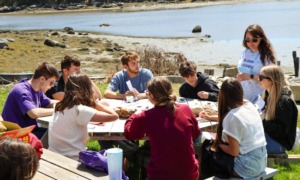
I can attest to the power of the advice above from our trainees. When resources allow (and we often have to advocate for the resources to make it happen), we design PD to have multiple sessions so we can build community among participants. We give people ample time to get to know each other, to share stories and to provide peer support. We try to honor their intellect with the big picture, but leave the group with specific takeaways they will always remember. We take groups to the woods, or to the beach, or to a rooftop — a new environment that gives them time and space to think differently about persistent challenges or new opportunities. For every opportunity we get to deliver PD, we try our best to make it as meaningful as possible.
Want to share what works in your PD to inform future articles?
Email me at info@changeimpact.net!
***
This piece is the latest in the Thriving Youth Need a Thriving Workforce Series. Previous pieces:
- What if we treat staff development as part of our core mission?
- From training to education: College credit for youth workers
- A restorative approach to professional development for youth workers
- College students can help close the gap between demand and availability for afterschool programs
- From turnover to graduation: Rethinking staff retention
- Investing in the OST workforce: Dreaming big and starting small
- In San Antonio, TX, youth development programs work together toward a shared vision of youth thriving
Jen Curry, Ed.D., is CEO and founder of Change Impact, a capacity-enhancing organization working with nonprofits, schools and systems to achieve results and advance equity for youth. This column marks her first anniversary as a columnist for Youth Today.