
All the best crime dramas open in the same way. It starts with a victim, a harsh light on the suspect, a folder slapped on a desk and a shocking confession that wraps up the case before the commercial break.
This past summer, I got the opportunity to intern in Hayward, California, at the Hayward Police Department’s Records and Property Bureau. I was inspired to reach out after sitting in on a City Council meeting in Dublin, California, at which District Attorney Ursula Jones Dickson delivered a presentation. I’ve always been intrigued by this form of public service, and when I reached out to Ms. Dickson to see how I could get involved, she pointed me to the bureau.
When I first heard “Police Records Department,” I expected something closer to enforcement — badges instead of binders. What I found instead was an incredibly welcoming and dedicated civilian staff, handling work that often stays “off the record” because it is quiet, procedural and easy to miss.
Past the uniformed officers is the department’s circulatory system: a web of counselors, youth coordinators and records staff whose work rarely makes the news but keeps the rest of the department functioning.

The interviews
To learn more, I wanted to interview staff from across the vital support teams. Clinical supervisor Lynnette Davis helped make this happen, providing access and guidance.
What I found was a fuller story from traditional policing. Several people I interviewed described HPD as a public resource instead of just an enforcement agency. As family counselor Melanie Clemons put it, the bureau’s approach is “supportive rather than punitive.” She added that residents should recognize the department as “a resource for all community members regardless of race, color, gender, origin, etc.”
The records department.
Start with the part that moves everything else along: paperwork. Roughly 37,000 reports pass through the department’s Records Bureau each year, and, as records supervisor Mattie Smith explains, records staff “touch every single report that comes through the agency [and are] the first faces the public sees.” Staff “require intense training and certifications, just like officers, to handle complex data.” The Records Bureau is also one of the clearest indicators of how much else runs through the building.
As an intern, the pace of the department became impossible to ignore as I watched case numbers rise steadily into the tens of thousands.
Records staff review officer reports for accuracy, redact sensitive personal information from body-worn camera footage and documents, process legal documents such as warrants and subpoenas, manage public requests, and help ensure court deadlines are met. According to Smith’s own description, Records is “quite literally, the ‘Heartbeat’ of the Police Department.”
But the work doesn’t stop here.
The youth diversion program.
My next stop: Hayward’s youth diversion program, Positive Youth Development (PYD), which works under the Youth and Family Services Bureau (YFSB). Consider a teenager’s first brush with the law. Whether it involves vaping, petty theft, marijuana possession, auto theft or assault, PYD tries to treat it as an opening to a second chance instead of letting it define the rest of their life. Minnette Simmons, who coordinates the department’s youth diversion work, points to the community’s “fear of having to encounter and deal with the police” as one of the biggest hurdles, and it’s amplified by “the stigma that comes from being housed in the police department.”
Working with youth has led Simmons to measure success by a shift in thinking rather than just compliance. Clients who once thought only “in the moment,” she says, soon progressed “to thinking futuristically,” which is “a success as a coordinator, but a total WIN for the youth because they did the work!”
City of Hayward
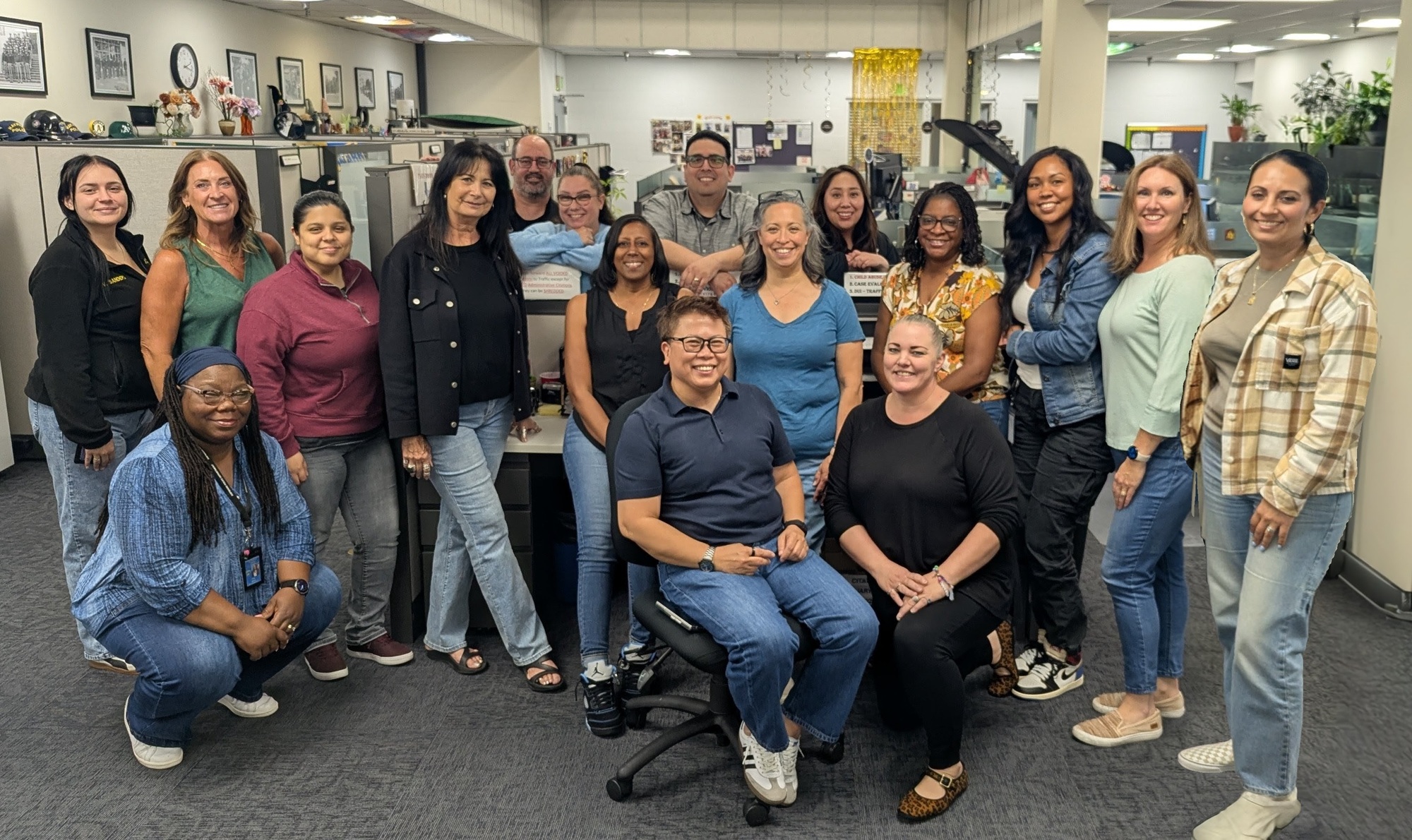
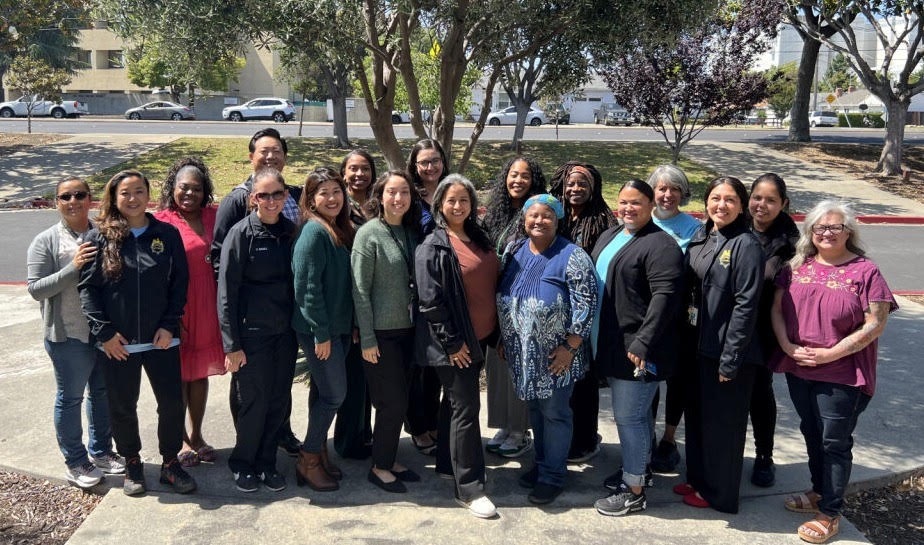
The Hayward Police Department’s Youth and Family Services Bureau (YFSB) staff pose for a picture.
The Resource Connection Network.
This theme of “help before handcuffs” shapes the department’s Resource Connection Network (RCN) and family counseling work. In a joint response, Clemons and Emil Kim — who are both in-house counselors — stated that they’re not law enforcement. Their job is instead “to help people express their feelings, … resolve issues and communicate more effectively.”
Conflicts that might otherwise escalate to law enforcement intervention, such as a teenager skipping school, falling behind in grades or not following family rules, can be turned into a referral instead.
One issue they grapple with, though, is that many clients face discomfort in “receiving mental health help” at all, a stigma they trace to “culture and fear.” They continue that they are “of the belief that in addition to law enforcement, we need to highlight rehabilitation and prevention if we are going to do right by our community.” For Clemons and Kim, prevention starts with conversation.
The partnership with the school district.
Some support starts even before students look for it. Through a partnership with the Hayward Unified School District that places YFSB counselors at three middle school campuses, many resources are readily offered, including crisis support, workshops on subjects from vaping to social media, and both individual and group sessions.
Frances Onia, a licensed marriage and family therapist who also sits on each campus’s Coordination of Services Team, says that
“Many families are surprised to learn that these services are free, accessible, and available directly on campus, eliminating barriers to care.”
Here, prevention comes in the form of a consistent presence where students need support most. According to Onia, an important next step is increasing the “awareness and understanding of counseling services,” which requires “better educat[ing] families and school staff about trauma and its impacts.”

Courtesy of Akshara Krishnan
Akshara Krishnan
The response and case management teams.
Meeting people where they are becomes more literal in a team that stretches beyond the department to other first responders. The Hayward Evaluation and Response Teams (HEART) run a Mental Health and Case Management Linkages Team (LINK) program that works to support adults facing homelessness, substance use or a mental health crisis. “Our team often has served as the gap finders — the bridge to service reconnection,” says Diana Lopez, a licensed marriage and family therapist and mobile mental health clinician who conducts assessments and supports people with self-regulation.
One of the harder tasks she describes is rebuilding the trust that has already been worn down. Lots of the people LINK serves, she says, “have been let down by many providers and are dealing with ongoing mistrust,” so progress tends to start small. “Once someone feels heard, understood, and seen, you have truly hit the jackpot,” she says. “Motivation begins to flow, hence the follow-through.” She emphasizes the need to see people “more as human and less as criminals,” and, before anything else, to simply ask, “Why did they do it in the first place?”
Whether it is a diversion case, a family referral or a LINK follow-up, many of those interactions eventually connect back to paperwork, which is where Records reenters and the cycle continues.
The takeaways
I came into the summer intrigued. I left with a mission.
The public picture of policing captures only part of the job. For many members of HPD, the challenge is making sure their work does not stay invisible. Publishing this article is one step toward making their contributions visible. Beyond this, I hope to continue examining the gaps in the system as a whole, from Youth Court and restorative justice to my policy research through PoliCrunch. Whether I am listening to young people in diversion programs, studying juvenile justice legislation or breaking down how public systems actually work, I want to keep asking the same question this summer taught me to ask: Where are people falling through the cracks, and what would it take to close those gaps?
Simmons put the takeaway plainly:
“We can’t be a help if we are not given the chance.”
***
Akshara Krishnan, a junior at Dublin High School, is passionate about youth justice and political science. She is a nationally ranked extemporaneous speaker and aspires to work in the field of law.