
When youth thrive, we all thrive.
The belief at the heart of all of our work remains unchanged: All youth have potential, but too many lack the opportunities, relationships and conditions to thrive — putting our communities, our democracy and our economy at risk. Public education is too essential to fail. And the broader learning ecosystem — the myriad spaces where young people live, learn, work, play and contribute — is too important to ignore. The boundaries of our evolving education architecture must expand to honor that reality, formalizing a commitment to anytime/everywhere/never-too-late learning so that young people can develop the competencies and skills they need to navigate a rapidly changing world.

When my colleagues Karen Pittman and Katherine Plog Martinez assumed responsibility for Youth Today in March 2025 and we launched the When Youth Thrive, We All Thrive series, we committed to connect the dots between specific stories and broader trends, to bridge research, policy and practice, and to provide a platform for ideas from and for the field. Later that fall, we introduced leaders to the Alliance for Youth Thriving — a growing community of national partners committed to ensuring that every young person has access to powerful learning experiences and supportive relationships across the full learning ecosystem. And last week, the Institute for Educational Leadership became the stable, supportive home for both efforts — as the new publisher for Youth Today and the home for the Alliance for Youth Thriving.
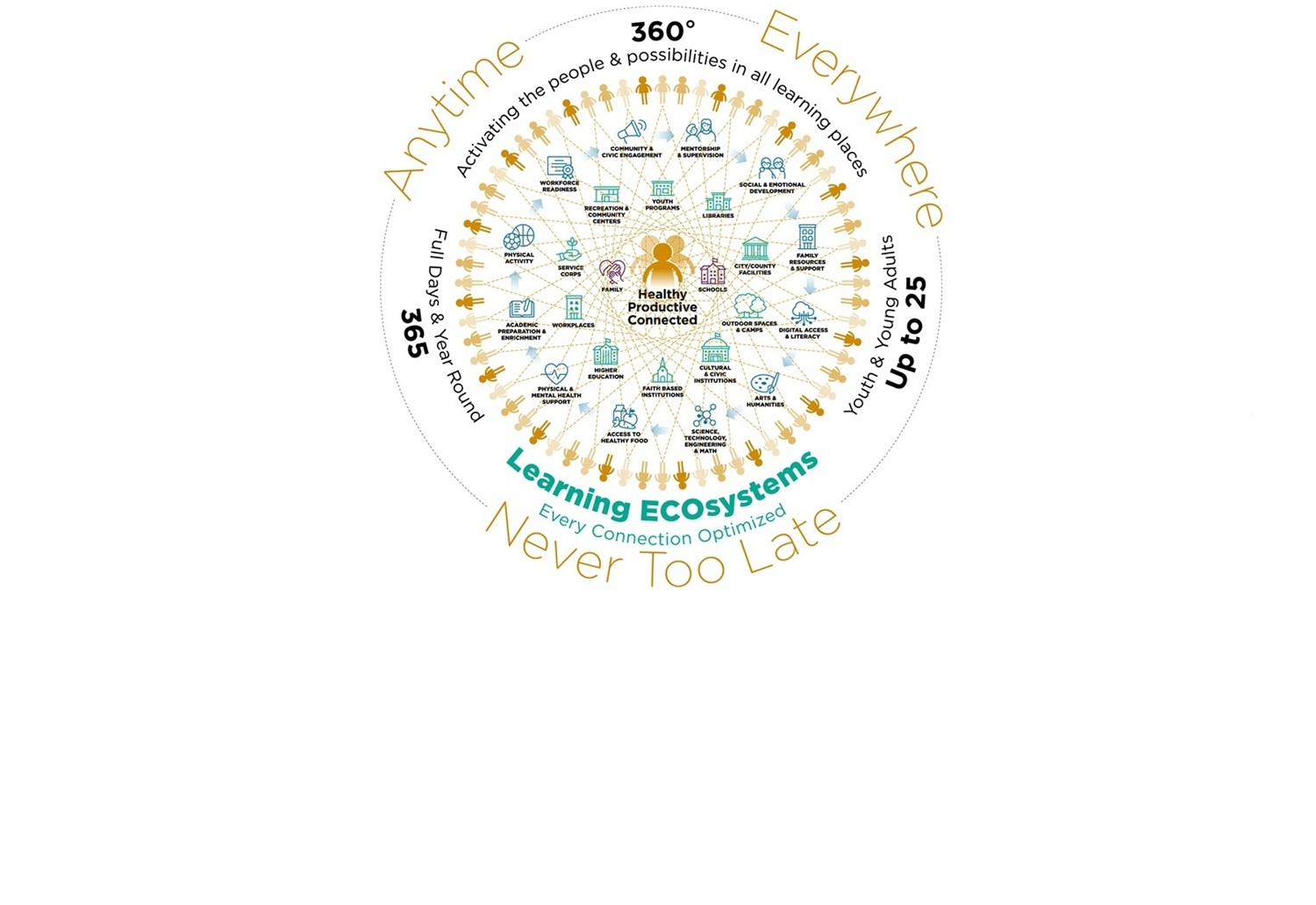
This week, at the inaugural meeting of the National Commission on Learning Ecosystems, we unveiled the Alliance for Youth Thriving’s new one-minute animated graphic on learning ecosystems.
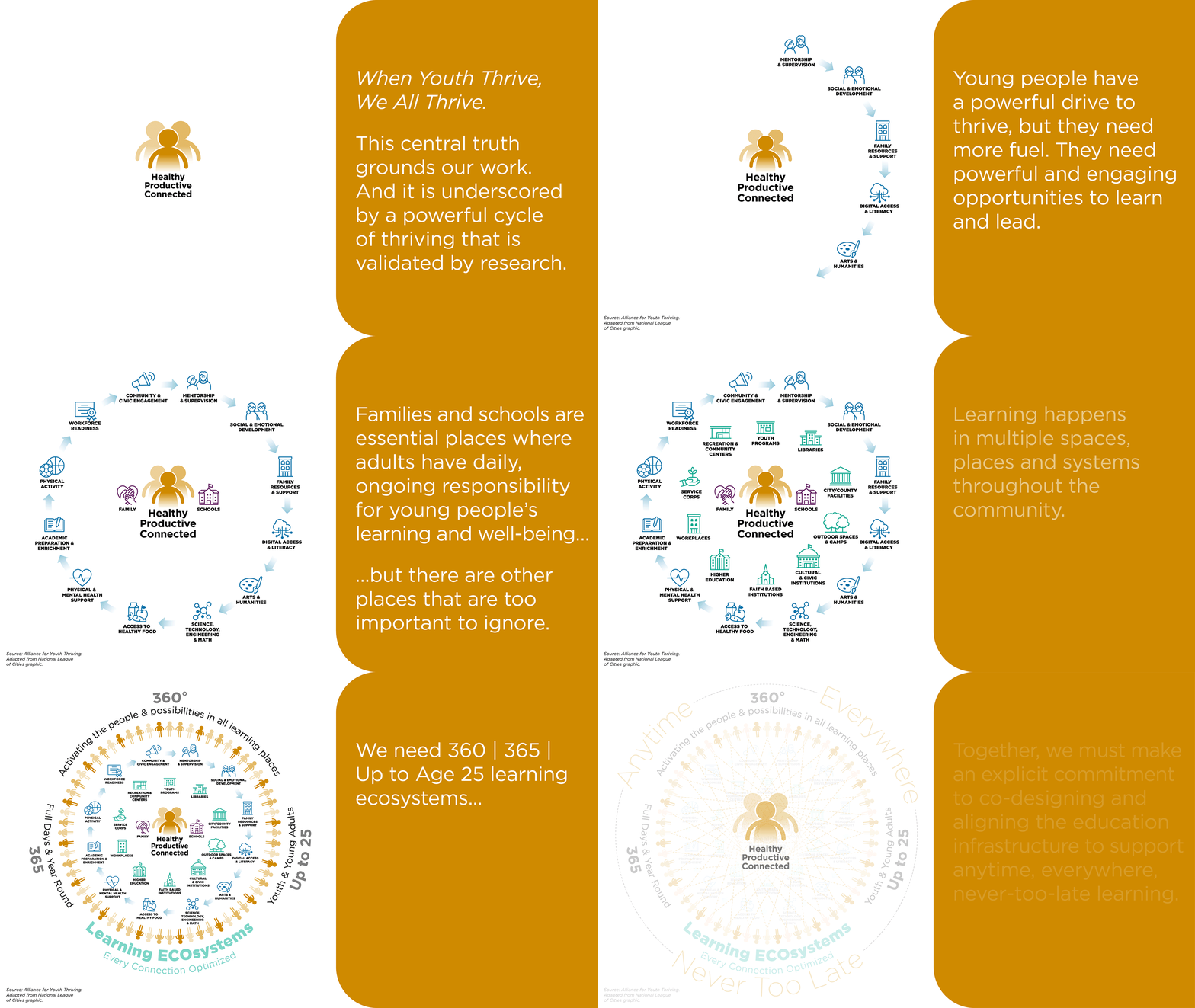
This visual and accompanying one-pager summarize the Alliance for Youth Thriving’s updated blueprint for action — also released this week. When Youth Thrive, We All Thrive: Why Ecosystems for Anytime, Everywhere Learning Are Too Essential to Ignore is a synthesis of perspectives developed in ongoing collaboration with our National Partners, grounded in the science of learning and development, the science of adolescence and positive youth development research. The ideas reflect the converging wisdom of youth, families, educators, business leaders and field practitioners across the full learning ecosystem, elaborated in a companion paper, Too Essential to Fail: Why Our Big Bet on Public Education Needs a Bold National Response..
With this convergence of energy and resolve, we are ready to move from belief to blueprint, and from blueprint to action. We invite you to join us.
Commitments for action
Too often, agreements about what matters for youth stay at the level of values. This collective statement from the Alliance pushes further. It translates a core set of beliefs into explicit commitments — claims about what we must do together, not just what we believe in principle.
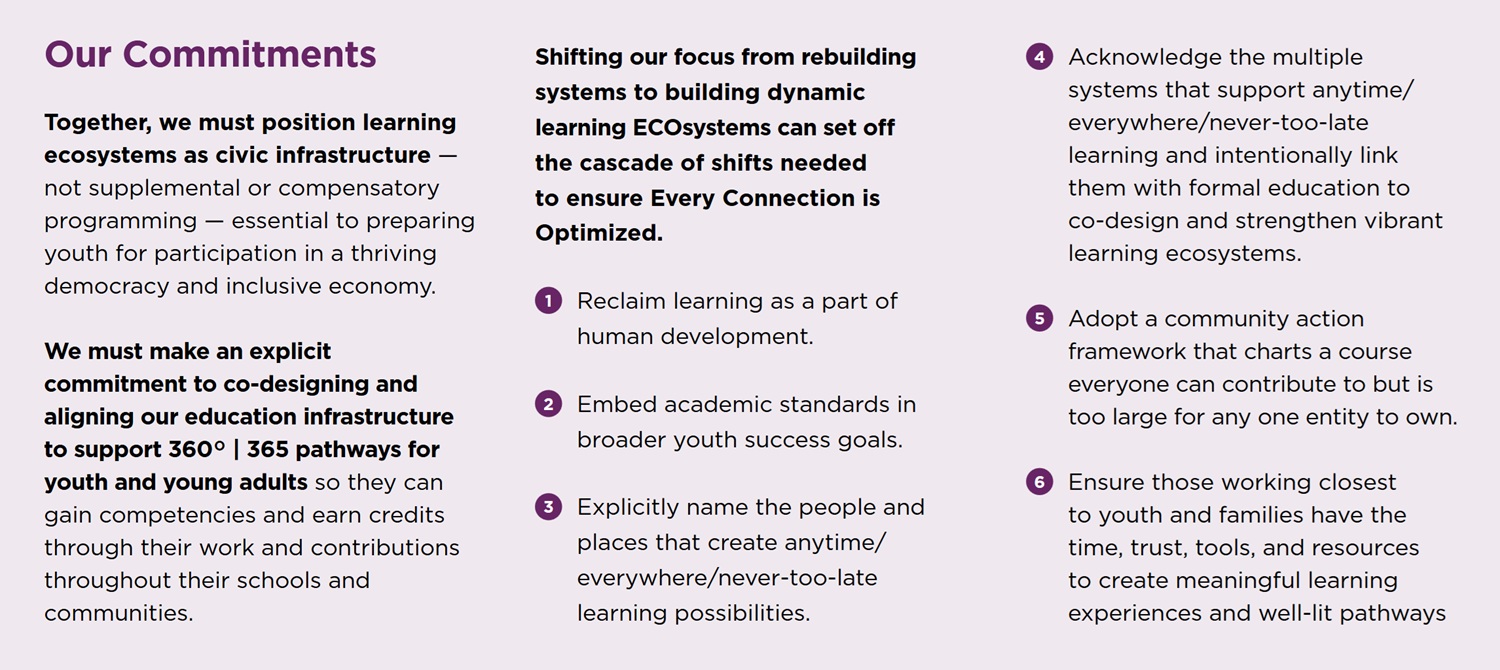
Together, we must position learning ecosystems as civic infrastructure — not supplemental or compensatory programming, but systems essential to preparing youth for full participation in a thriving democracy and inclusive economy. That positioning shift matters, because what gets funded gets done and what gets measured gets valued. Right now, we fund and credit only a fraction of the learning that actually happens in a young person’s life. We recognize seat time but not real-world skill-building. We validate what happens inside school walls but too often ignore what young people are learning, contributing and creating everywhere else. Changing that means ensuring young people are seen, recognized and credited for the full range of what they know and can do — no matter where, when or with whom that learning happened.
That requires a concrete commitment to co-designing and aligning our education infrastructure to support 360° | 365| Up to Age 25 pathways — so that young people, with the support of their families, can gain competencies and earn credits through their work and contributions in schools and communities alike, across the full day, the full year and through the transition to adulthood. Shifting our focus from rebuilding systems to building dynamic learning ECOsystems can set off the cascade of changes needed to ensure Every Connection is Optimized.
Four accelerators for shared action and innovation

Courtesy of Merita Irby
Merita Irby
Commitments require conditions to become real. The blueprint identifies four accelerators — the specific moves that build the trust, alignment and shared stewardship that transform aspirations into ecosystems. Each of these elevates the importance of a collaborative, connected and thriving workforce dedicated to thriving youth and families.
- The first is to affirm the common denominator. Across the diversity of sectors, organizations and roles represented in the Alliance, there is a unifying purpose: advancing a broad set of youth outcomes through powerful learning experiences. That shared north star is what makes cross-sector collaboration possible rather than merely aspirational.
- The second is to optimize the mesosystem — the web of relationships closest to youth. Young people thrive when the adults and institutions in their lives are connected, coordinated and working from a shared understanding of who those young people are and what they need. Strengthening those connections — between teachers and youth workers, between families and providers, between schools and community programs — is not peripheral to the work. It is the work.
- The third is to see and connect the systems — without circumnavigating schools. The goal is not to build parallel structures that bypass public education, but to make visible the full architecture of learning that surrounds it and to build the bridges that allow schools and ecosystems to work in concert.
- The fourth is to elevate and partner with ecosystem stewards and purpose-built intermediaries — the organizations and leaders who have been doing this connective work quietly and persistently, often without recognition or resources commensurate with their contribution.
The work ahead
If you believe in this vision, we invite you to go further.
Start by finding yourself in the larger picture. If you work with young people, you are already part of their learning ecosystem, and your daily work matters more than you may realize. Ask yourself where you sit in the ecosystem young people are navigating and what you can do to maximize your connections with others in it.
 Then ask the young people you work with: How do they see their own learning ecosystem? What sparks their interests, talents and passions? What experiences and relationships are helping them grow? What barriers are getting in the way? How can you help them increase their contributions and strengthen their connections to the people, places and possibilities that matter most?
Join us — as an Alliance Champion, a National Partner or a committed practitioner who is ready to optimize every connection within reach.
In the weeks and months ahead, Alliance National Partners will be sharing their perspectives and their work right here in this space. Together, we can enrich the learning ecosystems young people are navigating right now — and build toward more powerful, more connected ones for the future.
When youth thrive, we all thrive.
***
Merita Irby is managing partner of the Alliance for Youth Thriving, a partner at Knowledge to Power Catalysts, and a senior fellow at the Institute for Educational Leadership. She serves as strategic advisor and editor for Youth Today. She co-authored the seminal “Urban Sanctuaries: Neighborhood Organizations in the Lives and Futures of Inner-City Youth” and co-founded the Forum for Youth Investment with Karen Pittman in 1998, which they led together for nearly 25 years.