

A kindergartner refuses to pick up her pencil, throws her folder to the floor and won’t sit back down. A few grades later, a different student slides a test face-down across the desk and refuses to look at it. A teenager storms off a team practice rather than run one more lap. Different ages, different settings, but the same underlying signal:
Something is getting in the way of learning, working and connecting with others.

At Positive Education Program (PEP), a Cleveland nonprofit serving young people with developmental trauma and other serious challenges, we see this pattern a lot, and it isn’t unique to our students. Nationally, three in four high school students report having experienced at least one adverse childhood experience, and that kind of prolonged adversity can weaken the developing brain’s stress-response and attention systems, the exact skills a test, a group project or a job interview all demand. It’s tempting to treat refusal as defiance and respond with consequences, but that usually backfires because it addresses the behavior without addressing what’s driving it.
Courtesy of Lauren Nash
Lauren Nash
Consider Natalie (name changed for privacy), who came to PEP as a kindergartner after her public school exhausted its strategies. She wouldn’t sit for testing, wouldn’t participate in most classroom activities and was missing state-mandated assessments entirely. None of it was defiance for its own sake; Natalie had already experienced significant trauma, and her behavior was the only coping strategy she had.
At PEP, we knew it was more than testing accommodations that were needed. It was connection. Researchers call this co-regulation: a caring adult helping a child manage big emotions before the child can manage them alone, studied from infancy through young adulthood.
Trusting relationships with adults buffer a young person’s stress response, making coping strategies possible to teach and use in the first place.
We ground much of our work in Dr. Bruce Perry’s Neurosequential Model of Education (NME), which recognizes that young people’s brains are organized in a hierarchy. Sensory information is processed first by the brainstem (survival), then the limbic system (emotional), before finally arriving in the cortex (cognitive). When a child does not feel safe, the brain reacts with a fight, flight or freeze response, often before it can respond cognitively. Young people like Natalie, who have experienced trauma, often struggle with school, relationships and everyday tasks because they’re processing information while stuck in survival mode.
NME also emphasizes the sequence of engagement: Young people must first be calm (regulate) and have solid, trusting relationships (relate) before they can learn (reason), following the brain’s bottom-up order of brainstem, limbic system, then cortex.
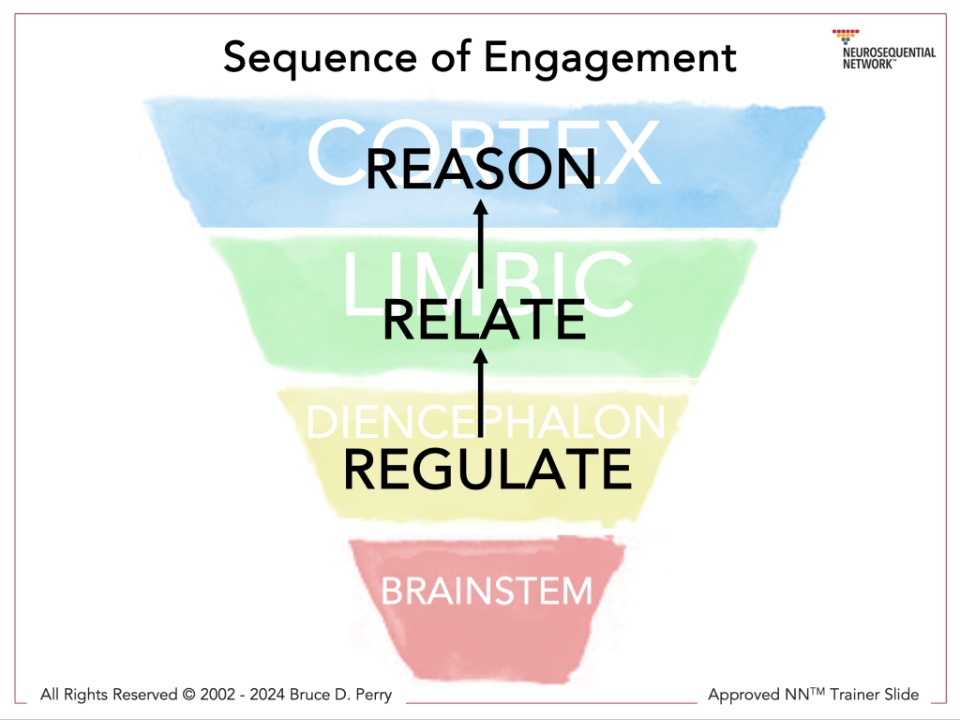
Neurosequential Network
.
Following this model, Natalie’s teachers immediately started strengthening their connection with her, accepting the parts of her that other adults had punished — such as her habit of pretending to be a cat — and letting her feel safe being herself. Once that trust was in place, she became more open to learning coping strategies and using the sensory room when overwhelmed.

Courtesy of Sweta Asher
Sweta Asher
Only with both trust and regulation in place could she engage with tests without shutting down.
By fifth grade, Natalie’s teacher, Kaitlin Merklein, could see the shift. “Today, when she gets frustrated, she’ll tell you what her coping strategies are,” Merklein said. Natalie now sits for testing and does her best to answer the questions, a small change that represents years of sequencing done in the right order.
That order is the transferable lesson, and it applies well beyond one therapeutic school or one test. The same regulate-relate-reason sequence explains why a student walks out of a group project, why a teenager shuts down during a disagreement with a friend, or why a young adult misses a job interview after months of steady progress. None of them are necessarily incapable of the task in front of them. They may simply be facing reasoning-stage demands while their nervous system is still stuck in survival mode.
There are three shifts any program can make:
Courtesy of Deanna Moore
Deanna Moore
First, treat refusal as data, not defiance. Before assigning a consequence, ask what regulation or relational need might be unmet.
Second, build a regulation option into high-stakes moments before they happen (a quiet corner, a movement break, a known adult check-in) rather than improvising after a young person is already dysregulated.
Third, invest in relationship building as infrastructure, not an add-on. The trust that helped Natalie regulate wasn’t built through a single intervention; it was built over time, before the crisis moment ever arrived.
None of this means lowering expectations or abandoning testing requirements, which are often legally mandated and useful for tracking progress.
It means recognizing that success in the classroom, on a team or in a first job runs through regulation and relationship first.
Programs that build that sequence into their design, rather than treating it as an accommodation for a few “difficult” kids, tend to see the same shift PEP saw with Natalie: fewer standoffs, more accurate data and young people who trust adults enough to try.
***
Lauren Nash is senior director of educational services at Positive Education Program and has worked in education for over 20 years. She holds a Phase I certification in the Neurosequential Model of Education and a Master of Education in educational leadership.
Sweta Asher is coordinator of curriculum and instruction at Positive Education Program. Her background includes more than 20 years in therapeutic school settings as an intervention specialist and instructional coach. Asher holds a Phase I certification in the Neurosequential Model of Education and a Master of Education in curriculum and instruction.
Deanna Moore is director of communications and marketing at Positive Education Program, where she is honored to tell the stories of the agency’s young people, their families and the professionals who support them. She has over 20 years of experience in communications and holds a Master of Public Administration in public policy and management.