


The child-serving workforce is in crisis.
Across the country, residential treatment programs, group homes and juvenile justice facilities are reporting record-high turnover. Many staff enter the field with passion but leave with exhaustion.
Staff are struggling, burning out and walking away.
But for youth to get the stable, relational care that supports healing, they need a workforce who can regulate their own emotional responses, despite carrying the weight of repeated exposure to youth trauma.
Because the reality is that youth don’t heal in isolation. They heal in relationship with adults who can stay grounded, see pain and model regulation.

How EQ2 started
In response to the deep disconnect between the care practices we aspire to provide youth and how we have traditionally supported staff, The Lionheart Foundation created EQ2. Its development was predicated on the knowledge that self-regulated and emotionally grounded staff are essential in providing effective trauma-informed care to youth.
The program’s origins are deeply rooted in the reality of direct care.
In the early 2000s, Lionheart was facilitating groups with systems-involved, trauma-impacted youth. Our programming used mindfulness and cognitive-behavioral therapy skills to help youth learn to manage triggers and heal from chronic adversity.
But after one session in a residential adolescent parenting program, a senior staff member pulled the Lionheart team aside and said,
“If you really want to help this place, create something like this for us.
We need the same skills and help the kids get.”
We knew that staff carried enormous stress, absorbing youth trauma with few supports to regulate their own emotional responses. But what we came to realize is that if trauma-informed care demands staff who can co-regulate, stay grounded and respond with curiosity rather than fear or frustration, we needed to provide them a structured path for building those skills.
How EQ2 is structured
EQ2 is not a one-time training. It requires a systemic shift in how we conceptualize supporting staff wellness.
It is a whole-agency intervention delivered through multiple connected pathways, including Circle practices, practical written tools, digital supports and self-paced learning for new facilitators. EQ2 employs a relationship-centered approach to strengthen the social-emotional capacities that relational work requires.
Why self-regulation is foundational to staff training
Courtesy of Beth Casarjian
Beth Casarjian
The research is clear: youth who have survived complex developmental trauma are exquisitely sensitive to the emotional states of adults. A staff member’s tone, posture, facial expression and level of arousal can either soothe a young person’s amygdala or hijack it.
But caring for trauma-impacted youth means staff are often put in challenging situations that activate their own survival responses. Over time, without structured emotional support, even highly skilled workers develop shorter fuses, heightened defensiveness and a reduced capacity to see the pain beneath difficult or unsafe behaviors. This pattern is particularly true for staff who enter these roles with their own trauma histories resulting in heightened stress reactivity. Our preliminary work with Purdue University shows that nearly 90% of direct care staff have been exposed to personal trauma.
Thus, self-regulation is the cornerstone of EQ2, blending cognitive-behavioral skills, mindfulness practices and restorative dialogue to help staff understand and reframe their own triggers.
EQ2 trained staff consistently report that learning to regulate themselves affects every part of their work: how they approach crisis, interact with peers, speak to youth and interpret behavior. These skills spill into home life as well. One staff member shared that she used the grounding exercises from the EQ2 app during a personal medical emergency.
When we better support staff, we support the entire system
After EQ2 training, one agency in the Midwest reported that staff began apologizing to youth more readily, repairing ruptures instead of letting frustration fester.
Another noted that conflicts among staff decreased as colleagues learned to communicate from a calmer, more reflective place.
Lakemary Residential Services in Kansas said that through the program, staff not only became more emotionally aware, but they developed stronger and more compassionate connections with the youth in their care.
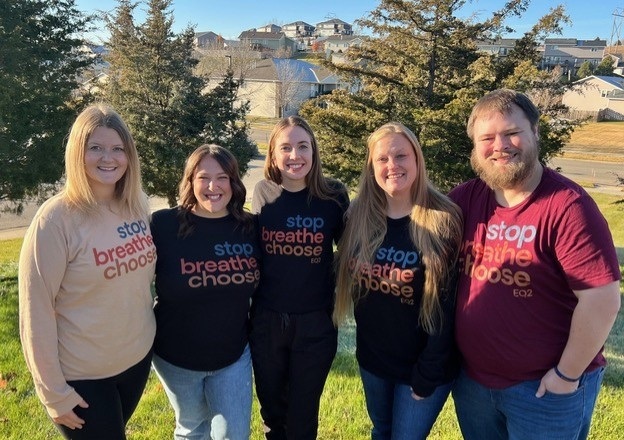
Dakota Boys and Girls Ranch
Staff from the Dakota Boys and Girls Ranch in North Dakota pose for a picture in matching program shirts.
Why staff-support programs like EQ2 are no longer optional
If we want trauma-informed care to succeed, we need to support those caring for youth.
Nationally, turnover in residential and juvenile justice settings continues to be a deep pain point. Studies show that secondary traumatic stress and burnout are among the strongest predictors of whether staff remain in the field. When staff leave, programs rely heavily on overtime, inexperienced replacements or temporary workers, further weakening the stability young people rely on.
Breaking the turnover cycle requires systemic attention to staff wellness, not as an afterthought but as a core component of ongoing training and support.
Direct care staff are not peripheral. They are central, providing the everyday micro-interactions that shape healing.
Supporting them is the most powerful lever we have.
Youth cannot heal in vacuums. And neither can the adults who care for them.
Case study: The state of Kentucky
Use: Kentucky is using EQ2 in residential treatment and juvenile justice centers statewide
Objective: Part of a broader effort to stabilize the state’s child-serving workforce and improve outcomes for young people with serious trauma histories.
Results:
• A significant decrease in critical incidents between staff and youth.
• Staff reported becoming more aware of their own emotional state, more capable of calming themselves during escalation and more confident in using trauma-sensitive strategies before behaviors intensified.
• Program leaders reported that as staff became more regulated, youth became more regulated, de-escalation happened earlier, power struggles diminished and the tone of interactions shifted from reactive to relational.
***
Bethany Casarjian, Ph.D., is the executive director of The Lionheart Foundation and co-author of three nationally utilized, trauma-informed programs designed to increase social and emotional regulation skills, reduce risk-taking behavior and increase the growth and well-being of youth and staff. Dr. Casarjian’s work has been funded by the Substance Abuse and Mental Health Services Administration (SAMHSA) and the National Institutes of Health (NIH). To date, she is a co-investigator of the largest U.S. study examining the impact of mindfulness with incarcerated male youth.