


Youth homelessness doesn’t begin when a young person enters a shelter. It begins much earlier.
Family instability, school disruptions and justice involvement are among the warning signs that emerge when young people are already interacting unsuccessfully with public systems. Over the past decade, Washington state has shifted its approach from crisis response to prevention. Washington leads by example with its Housing Stability for Youth in Courts (H-SYNC) model, which has proven to be not just a successful program but an illustration of a broader lesson about youth homelessness.

Why Washington changed its approach
The state’s approach shifted around 2015 when community advocates and young people with lived experience noticed patterns emerging where youth homelessness was showing up across multiple systems such as education, child welfare, juvenile justice and behavioral health. At that time, there was no office or position in the government responsible for youth homelessness and no single, reliable data source. Conversations around the crisis grew louder as advocates began looking at ways to fill the gap with new policies.
In 2015, advocates helped the state legislature pass the Homeless Youth Prevention and Protection Act and created the Washington State Office of Homeless Youth (OHY) within the Department of Commerce. The office works on five priorities: stable housing, family reconciliation, permanent connections, education and employment, and social and emotional well-being.
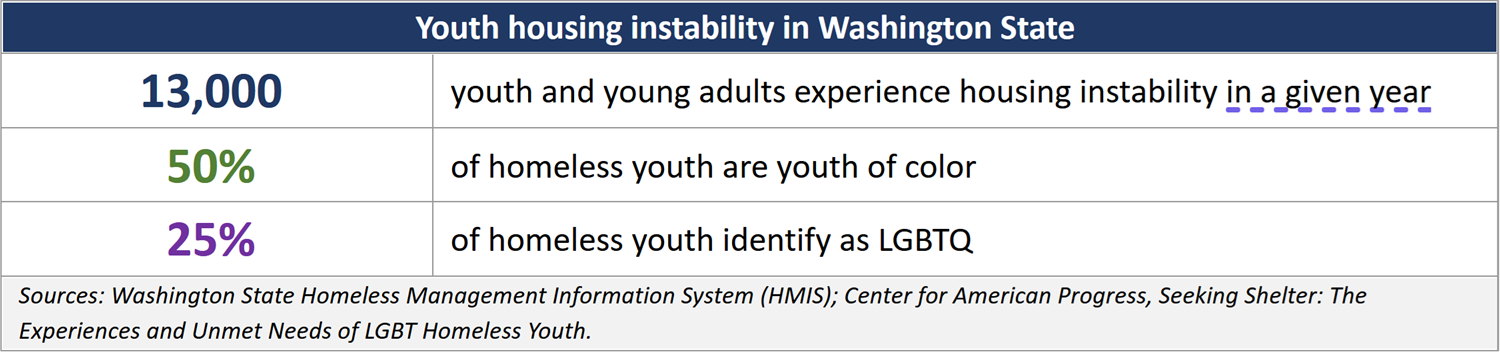
The data convey the story. The state has seen a 40% reduction in youth homelessness from 2016 to 2022. LGBTQ youth and youth of color remain disproportionately represented, and about 13,000 youth and young adults experience housing instability in a given year. Equally important, 75% of youth and young adults permanently housed in 2020 retained stable housing two years later.
What prevention looks like in practice
With responsibility for youth homelessness firmly assigned to the government, Senate Bill 6560 was introduced in 2018, stating that no youth should be discharged from a publicly funded system of care into homelessness. Youth homelessness became a shared public responsibility, and the Housing Stability for Youth in Courts (H-SYNC) model helped transform policy into sustainable implementation through cross-collaboration.
The H-SYNC model changes the question from “how do we house homeless youth?” to:
“How do we recognize housing instability before homelessness occurs?”
Developed by Snohomish and Kitsap County multisector workgroups in 2018, the H-SYNC is a continuum-of-care intervention. The model uses a “cascade model” that leverages existing processes in the juvenile court system to identify youth at risk of homelessness and refer court-involved youth to support services in their community.
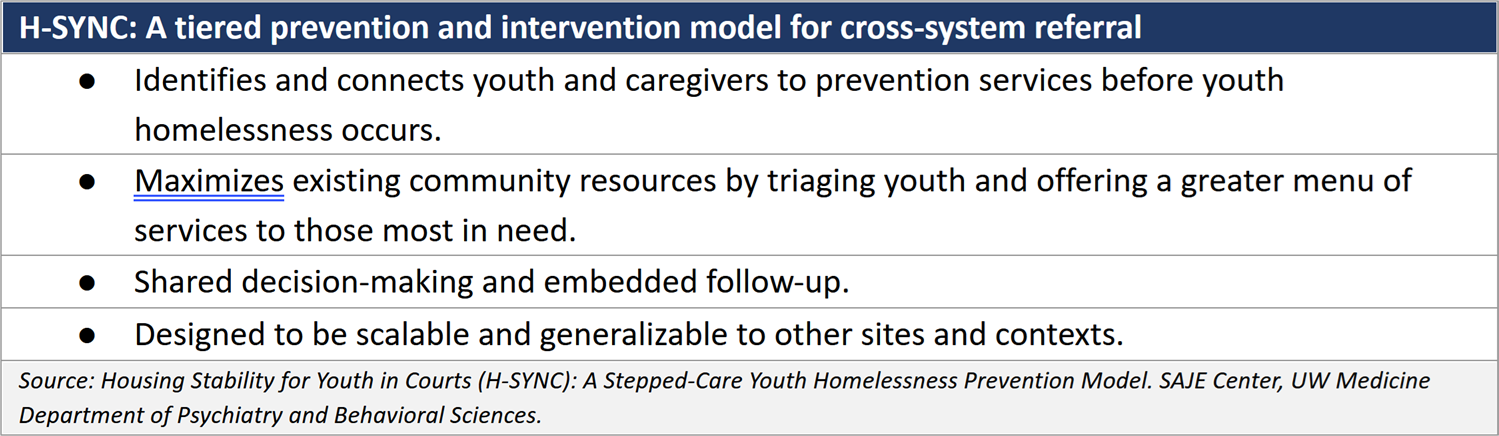
Once at-risk youth are identified, they are referred to the Housing Stability Coordinators, who will conduct an in-person intake assessment to triage referrals and tailor services to the needs of the participant and household, including cash, food and utility assistance.
[Related: I lived in a coat closet to stay in college]
Studies have shown that participants in H-SYNC were five times more likely to engage in recommended services. What makes this program a good model for others to follow is that it is well aligned with existing court practices.
Lessons for youth-serving systems
Youth homelessness is not the sole responsibility of housing providers. Teachers, social workers, behavioral health providers and probation officers often see the warning signs before a young person loses stable housing. H-SYNC identifies and connects youth and caregivers to prevention services. Homelessness rarely happens without any warning.
Existing touchpoints are prevention opportunities. Many youth at risk for homelessness are already connected to public systems, and H-SYNC emphasizes using existing community resources. By implementing housing stability or risk screenings using data from existing processes in the juvenile court system, such as H-SYNC’s model, communities can identify risks early and connect young people with relevant support before a crisis develops.
Collaboration must be intentional. Cross-system partnerships only work when there are clearly defined referral pathways and a mutual understanding of each agency’s role. H-SYNC is an example of how service gaps can be filled while helping young people navigate the system. For example, when Nevada completed its first statewide study on youth homelessness in 2025, it found that a large number of young people had fallen through the cracks of systems, which is what H-SYNC works to prevent.
Prevention strengthens positive youth development. Washington approaches youth homelessness as part of a broader youth development framework. Stable housing under the OHY also includes family reconciliation, permanent connections, education, employment, and social and emotional well-being. Homelessness prevention is being framed as positive youth development, and that’s the difference between prevention and crisis response.
Final thoughts

Courtesy of Jason Collins
Jason Collins
H-SYNC’s success in the state of Washington illustrates that when policy creates the conditions for agencies to work together, prevention becomes a practical strategy rather than a faraway goal. H-SYNC was supported by state legislation. But the practice spread county to county.
If you are interested in testing the waters in your community or state, start by asking these questions:
Are we identifying young people at risk before they lose their housing?
Are we sharing information and resources across agencies?
Are young people being referred from one service to another?
What barriers prevent young people from getting help early?
Are we actually listening to young people’s experiences when designing solutions?
Washington’s policy change reminds communities and other governments that youth homelessness starts well before a person is without a home.
***
Jason Collins is a writer, journalist and researcher with more than 10 years of experience examining the systems and processes where social need and infrastructural failure intersect. While he does not have lived experience with homelessness, his reporting is grounded in close examination of the systems at play, without losing sight of the human element that ties it all together.