

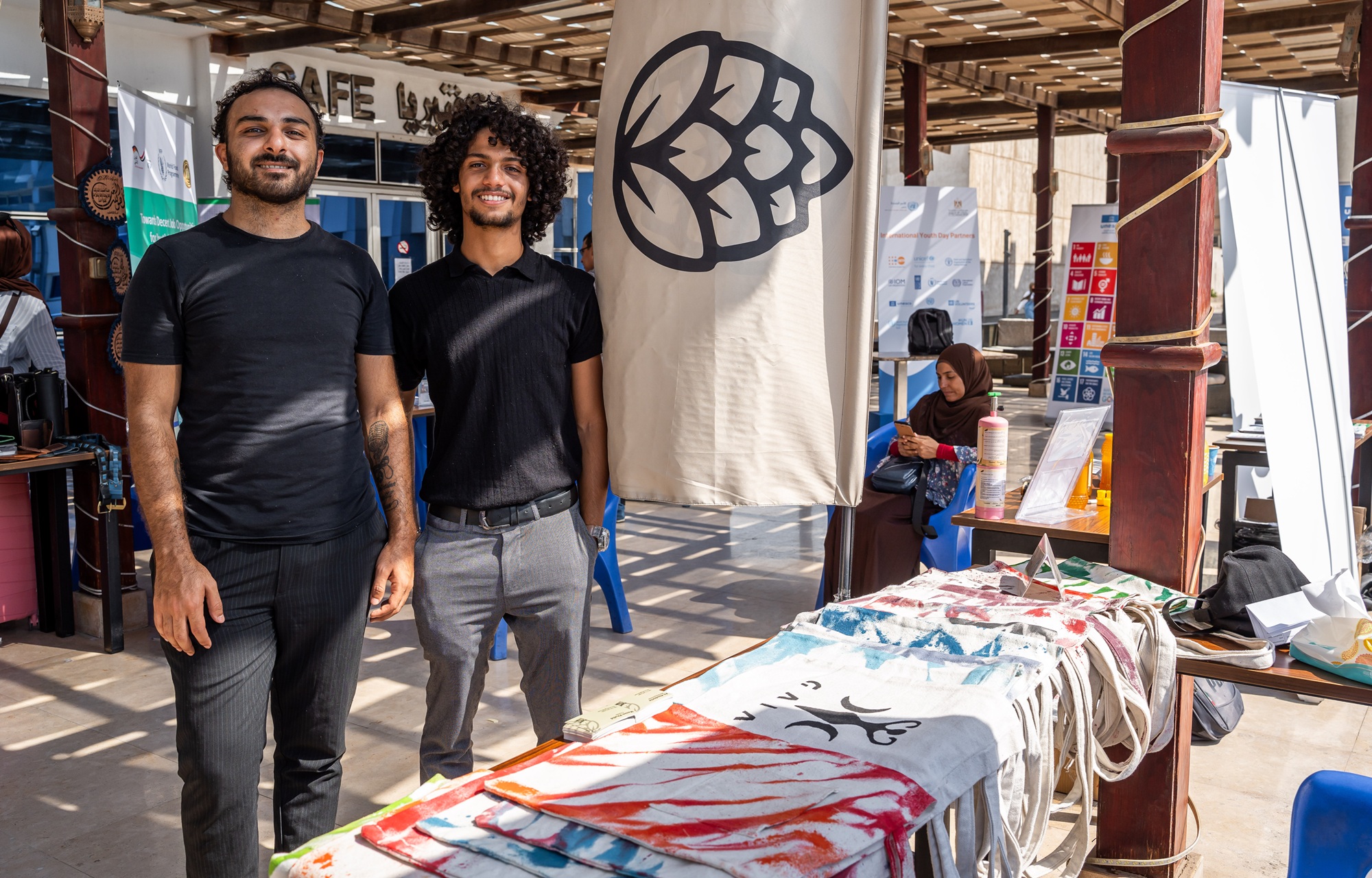
Across the world, young people are doing what is asked of them.
They are attending training programs, completing business courses, opening bank accounts and launching small enterprises. And yet the evidence is unambiguous: Youth unemployment climbed to 12.4% in 2025, with around 260 million young people not in education, employment or training (NEET). In low-income countries, NEET rates are a daunting 27.9%. In contexts shaped by conflict and fragility, many young people are doing everything asked of them under conditions that would stop most of us before we started — and still finding that the pathway to sustainable opportunity remains closed.
The reason is not that the training was wrong…
Not that the young person was not ready…
But that the economic environment they are stepping into was not yet built to receive them.

That is the gap practitioners working in youth employment have learned — slowly and sometimes painfully — to name more honestly. Skills matter. Finance matters. Entrepreneurship matters. What also matters, and what receives less consistent investment, is the connective infrastructure that turns each of those ingredients into a genuine pathway to economic participation.
The World Bank projects that by 2030, fragile and conflict-affected economies will account for nearly 60% of the world’s extreme poor, up from 50% in 2024. Young people in these settings face disproportionate exclusion from formal employment and economic participation. In the United States, youth entrepreneurship has continued to grow in recent years, including among Black, Latino and immigrant entrepreneurs, illustrating that the search for economic opportunity is shared across very different contexts. For young women across all contexts, the barriers compound further: limited mobility, unequal access to finance and social constraints on market participation mean that even well-designed interventions can fall short if they are not explicitly designed to reach women where they are.
Skills are the right place to start that conversation. World Youth Skills Day on July 15 reflects a genuine and important commitment: that young people deserve access to the knowledge, capabilities and practical tools that make economic participation possible. The evidence supports this. Young people who complete business training, develop financial literacy and acquire enterprise skills are better equipped to navigate difficult economic environments than those who do not.
But skills are a foundation, not a ceiling. They are the starting point of a pathway, not the pathway itself. A young person who completes a business training program and has no access to start-up capital cannot launch an enterprise. A young person who receives a grant and has no access to customers, suppliers or follow-on support cannot sustain it.
A young person who builds a viable small enterprise and has no access to the next level of finance cannot grow it.
Consider a young woman in a city shaped by years of conflict who has completed a business training program and used a small grant to launch a food production enterprise from her home. Three years later, her business is still running. Her household income is more stable than it was before. Her children are in school. By most measures, this is a success — and it is.
But she has not yet accessed the formal credit she would need to expand her production, reach new customers or hire additional help. Not because she has not tried. Because the financial products available to her were designed for borrowers with collateral, transaction histories and documentation she does not have. The skills and the grant did what they were designed to do. The pathway ended where the next institution should have begun.

EAA Foundation
EAA Foundation’s Digital Financial Inclusion Project in Sri Lanka is helping young people gain digital financial literacy and start their business.
What does a complete pathway to business success look like in practice? Field experience points consistently toward five connected elements.
- Skills and enterprise knowledge provide the foundation — business training, financial literacy and practical capability that allow young people to identify opportunities and manage resources.
- Access to appropriate finance enables action. But financial exclusion remains a structural barrier. Grants and microfinance products must be calibrated to the realities of young entrepreneurs without collateral or documentation. And for young women, who face the sharpest exclusion, that calibration requires specific design, not general eligibility.
- Mentorship and peer support bridge the gap between training and sustained enterprise. The period immediately after an intervention is when young businesses are most vulnerable and when practical guidance matters most.
- Market access connects skills and finance to customers. In settings where supply chains are disrupted and customer bases depleted, linking young enterprises to local, regional and digital markets is a core program component, not an add-on.
- Enabling economic conditions — macroeconomic stability, functional financial infrastructure and regulatory environments that support small enterprise — are what no single program can provide alone, but every program depends on. These require policy commitment and sustained engagement from governments and the private sector alongside development actors.
Together, these elements form a pathway. Individually, each is necessary. None is sufficient alone.

Courtesy of Abdullah Mohammed Kassim
Abdullah Mohammed Kassim
And the pathway to entrepreneurship is becoming increasingly important for U.S. youth. The U.S. currently has one of the highest youth entrepreneurship rates among advanced economies. One quarter of 18- to 24-year-olds were actively starting or running a new business in 2024, nearly double levels seen a decade ago. Almost two-thirds of young people report going this route because of job scarcity. The biggest motivation for youth entrepreneurship in the U.S. is necessity, not opportunity.
The practical implication for all regions is not to abandon what is working. Skills programs are working. Integrated financial support is working. The evidence confirms that well-designed, independently monitored interventions produce real improvements in the lives of young entrepreneurs, even under extraordinary conditions.
A skill without an opportunity is preparation without a destination. In stable economies with functioning markets and accessible financial systems, skills reliably find their way. Where markets are disrupted, institutions are weak and financial infrastructure reaches only a fraction of those who need it, the pathway from skill to opportunity must be actively built — component by component, with the same rigor and sustained investment that skills development itself requires.
Young people are ready. The question is whether the systems around them are being built to receive them.
***
Abdullah Mohammed Kassim is an enterprise development manager at the Education Above All (EAA) Foundation’s Silatech programme. He has more than 20 years of experience in international development and specializes in youth economic empowerment, entrepreneurship, financial inclusion and employment.