
“Don’t believe the hype.”
— Public Enemy
“Reading the world always precedes reading the word.”
— Paulo Freire

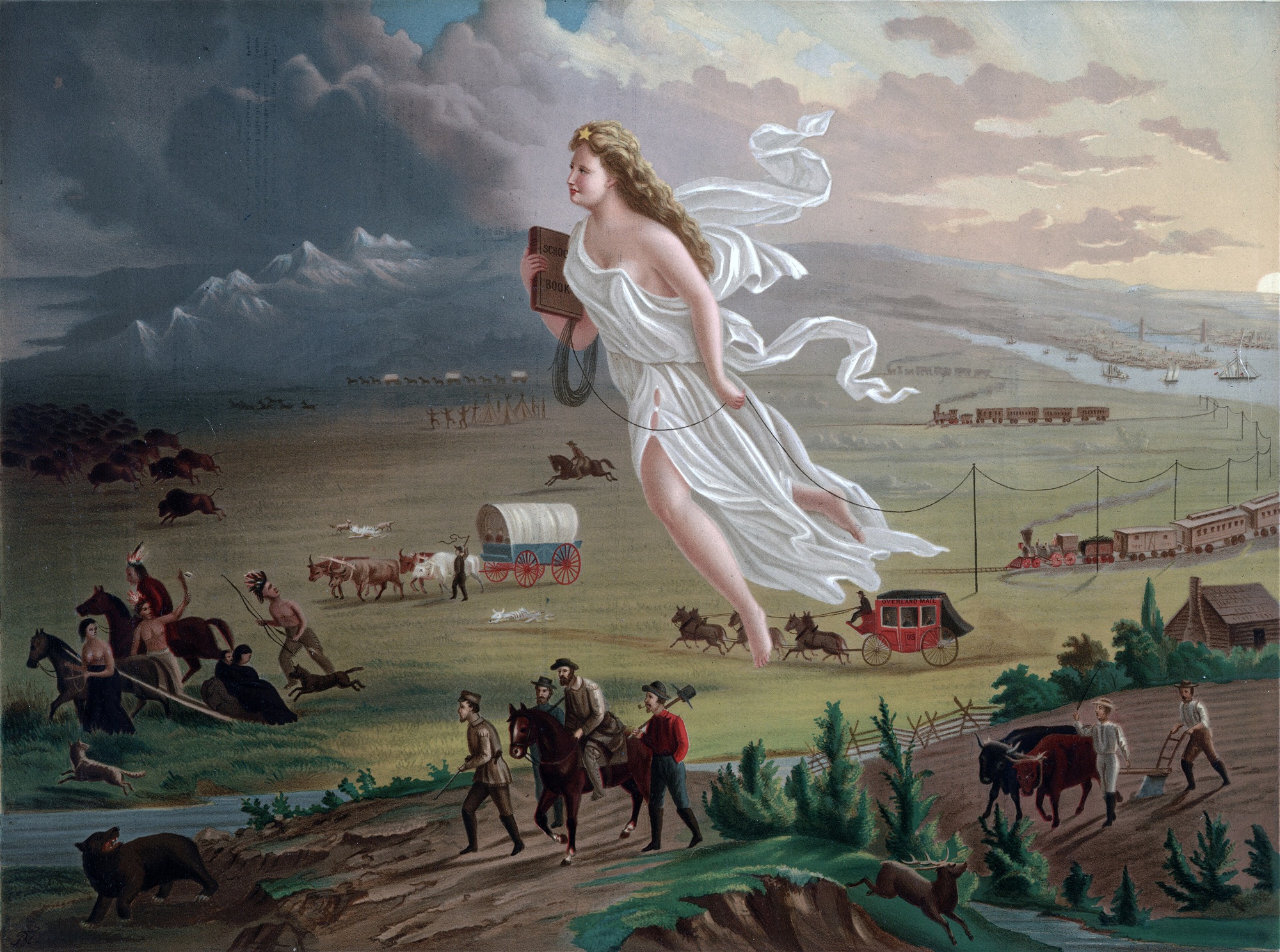
 I remember seeing a painting in social studies class of a woman floating westward across the continent, glowing in white, carrying a book. Behind her were farms, ships, railroads, towns and light. Before her were Native people, buffalo, wild animals and darkness, all being pushed toward the edge of the frame. This was John Gast’s “American Progress.” What I didn’t know until recently was that the woman was Columbia, the female personification of the United States, and that she was carrying a telegraph wire in one hand and a book in the other. I assumed the book was the Bible. Upon closer inspection, it says “Schoolbook.” I was intrigued.
The message was now clear to me: Civilization is arriving. Communication is arriving. Schooling is arriving.
Educational historians like Joel Spring have noted that nineteenth-century schooling was not only a benign push for literacy. It was also a policy of deculturalization, using schools to dismantle a people’s language, history and sovereignty and replace them with Anglo-American norms. For me, the schoolbook may be the most revealing object in the painting because it exposes the arrogance at the center of the image. Columbia is not simply bringing education. She is bringing a premade idea of Schooling: formal, institutional, book-based and settler-defined. The painting asks us to see that book as progress. It also asks us to ignore the forms of knowledge already present in the darkness.
The people living there were not uneducated. They were educated differently. Developmental psychologist Darcia Narvaez has argued that Indigenous worldviews begin from a radically different premise than the dominant Western one: human beings are not separate from nature, but nested within a living web of relationships, responsibilities and reciprocal obligations. That kind of education was carried through language, story, ceremony, observation, memory, practice and relationship. Children learned how to read weather, follow animals, understand plants, prepare food, honor kinship, recognize danger, share responsibility and live within the limits of a place. Education was not separate from life. It was how life continued.
Columbia’s schoolbook, then, does not simply symbolize learning.
It symbolizes the dismissal of culture.
That dismissal matters because settlers moving west were entering environments many of them did not understand. A book from the East (U.S.) could teach reading, arithmetic, scripture, citizenship and national identity. But it could not, by itself, teach the daily work of making life possible in a new landscape. The knowledge most urgently needed in those places was often place-based, practical, ecological and communal. Much of it was already held by the people being displaced.
[Related: A flashlight on the life spaces of young people]
People have always migrated, traded, borrowed, taught, married, adapted and learned from one another. There were surely things settlers knew that could have been useful to Native communities, just as there were countless things Native communities knew that settlers urgently needed to understand.
That is the ordinary and humane version of cultural exchange: people meeting one another with curiosity, humility and practical need. That is dialogue.
But that is not what “American Progress” shows. The painting does not imply mutual learning. It moves in only one direction. Columbia does not arrive as a neighbor. She arrives as a teacher. She does not ask what is already known. She assumes need and want.
That is the real failure of Columbia’s schoolbook: she brought education without listening.
Settlement without humility becomes possession.
Education without listening becomes conquest.
That pattern has not disappeared. It has only changed direction. Today, the imposition is from well-resourced (and well-intentioned) “American-dream groups” to under-resourced communities. Adults, institutions, philanthropies and policymakers arrive with their own schoolbooks: everyone should go to college, every child needs a laptop, every school needs the same pathway to success, every community needs the same innovation.
Some of these ideas are useful. College can open doors. Technology can expand access. Credentials can matter. But when these solutions arrive already written, they can repeat Columbia’s mistake. They assume the problem is absence: absence of aspiration, absence of knowledge, absence of tools, absence of culture. They do not always begin by asking what is known and what is meaningful.
[Related: People want to help youth who are brave enough to be different]
The geography has changed, but the posture can remain the same. What I see resulting from this are “successful” young people who have learned how to succeed inside school rather than how to live well outside it. They may know how to perform the rituals and routines of a stranger’s vision, yet feel disconnected from their bodies, communities, environments and practical responsibilities.
Environmental educator David Orr famously argued that the planet does not need more “successful” people in the narrow institutional sense; it needs people who know how to inhabit a place well. Modern education often separates knowledge from place and people. It teaches students to master symbols while losing fluency in the living systems that sustain them.
A different book may have been better. Or perhaps it would not have been a book at all. It might have been a seasonal calendar, a bundle of stories, a set of tools, a map drawn by those already there, a packet of seeds, an empty notebook. It might have taught reading and writing, but also tending, repairing, growing, observing, sharing and belonging.
Columbia’s mistake was that she brought a book already written.
She should have brought an empty one — and learned how much was already known.
Oh, I should probably acknowledge that there are no hip-hop references here. Sorry.
***
Pass the mic: Where hip-hop meets human development. Each month, Daniel Warren, Ph.D., will bring scholars and rappers into dialogue to spark new ways of seeing youth, culture and change. Previous pieces in series:
You might also like: The problem with learning styles
Structure, control and leaving room
Look inside: What MCA taught us about gratitude, growth and growing up
Shifting the game: Kuhn, hip-hop and the future of youth work
When positive youth development meets the Native Tongues
Biggie through Bronfenbrenner’s Eyes
Daniel Warren is director of youth development and education at Fluent Research. He holds a B.S. in psychology from Northeastern University and a Ph.D. in human development and child study from Tufts University.