
Tuesday’s When Youth Thrive, We All Thrive post invites readers to explore the trust gap between youth and adults that many young people tell us holds them back from being bold changemakers because they aren’t informed about, invited or given opportunities to influence and implement decisions that matter to them.
Today, I invite you into the behind-the-scenes story of how a 13-year-old trusted himself enough to design a brilliant solution to a much talked about problem — youth mental health.
Shourya Kancharla is founder of Simple Minds Matter, a nonprofit that has been approved by the Frisco, TX Independent School District as a vendor to bring affordable, confidential online therapy to high school students. Read the details of the fall launch in this June 8 Associated Press article.

Q: I understand that the idea for Simple Minds Matter was born out of a personal tragedy.
Shourya Kancharla: Yes. At the end of my seventh-grade year, in that summertime, one of my cousins passed away. He was concerned about the country’s direction and getting more involved in politics. But the biggest thing was he did not share his thoughts, share his pressures, with anyone. No one really knew he was suffering until it happened. I thought that was the biggest problem: My cousin didn’t feel comfortable enough to share what he was going through with anyone.
Q: Is it fair to say that there was no one he could trust to understand what was troubling him the most?
I feel like trust and being comfortable are two separate things. I trust my parents, but I’m not comfortable sharing some things with them. But my cousin’s death got me thinking. He was 22. He had a job. He could have afforded therapy. It was his choice not to use it. But the problem is much larger for high school students.
For all high school students, but especially those in underrepresented communities, it can be hard to find someone you can be comfortable sharing with privately.
Q: So, you were 13. How did this concern translate into an idea for a business?
That same summer, I ended up applying to a local program called the Young Entrepreneurship Academy offered by our Chamber of Commerce. It was like a youth startup accelerator. They taught us how to start and create a business, how to market it, and all of that.
I thought that was a good opportunity to look at a problem that I found in my society and create a solution.
My first idea was a little different. The idea back then wasn’t about keeping the students’ identity anonymous. It was basically about getting therapy from their own school counselors. But after going through a little bit of trial, after talking to some people, we changed up the whole idea. Now we’re using outside school therapists, and once a parent gives consent, the sessions are private.
Q: As I understand it, you’ve taken almost two years to get ready to implement, hopefully this fall. Walk us through the steps.
With Shourya’s permission, I’ve used the TrustYouth actions list to explore the steps he went through to engage adults to help him implement his idea.

Courtesy of Shourya Kancharla
Shourya Kancharla
Information. So the first people I shared this idea were my mentors and then with my own school counselors. I quickly learned that the majority of high school counselors don’t have licenses to be therapists. Their jobs are entirely different. So, I knew we needed to switch up our path.
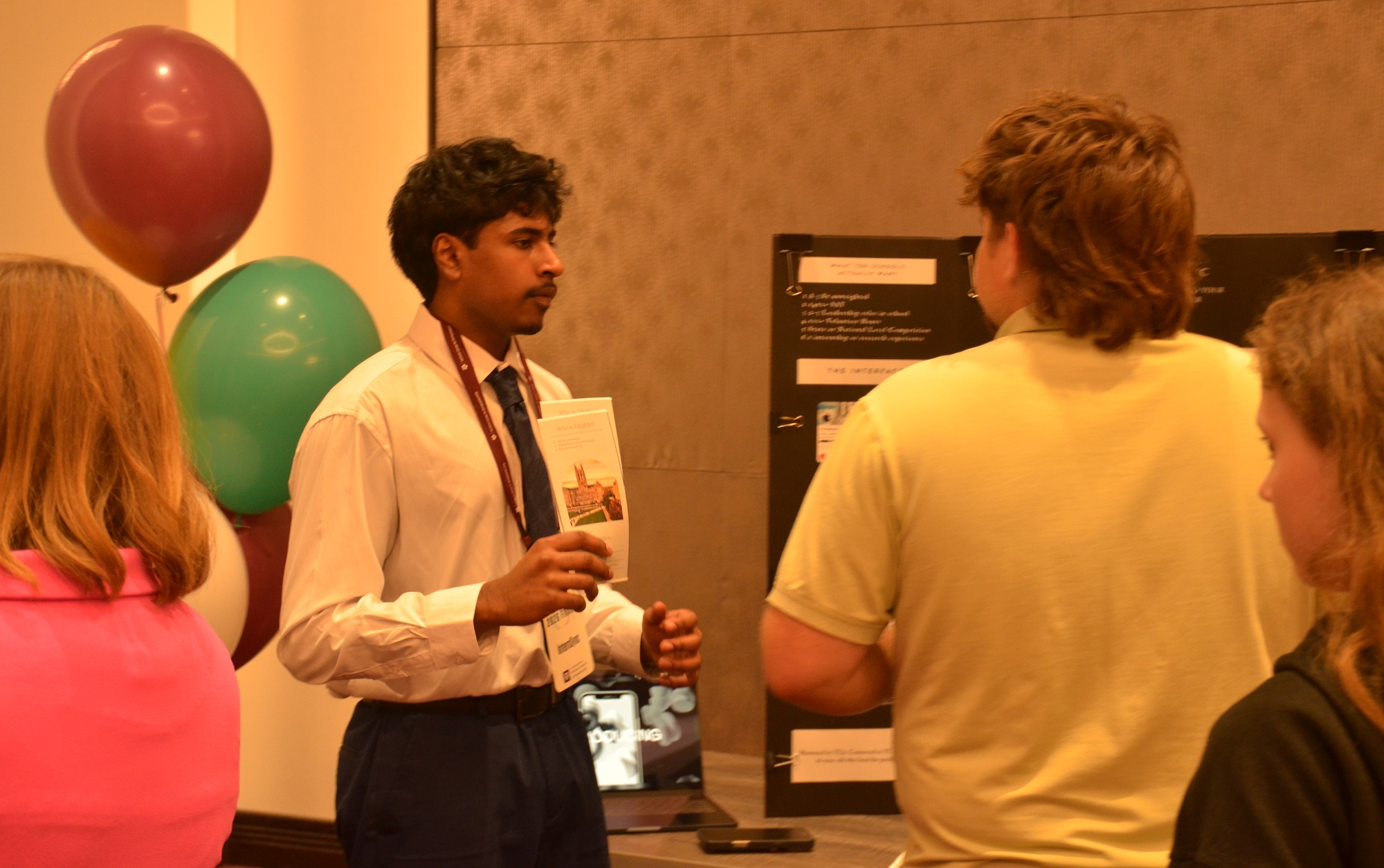
Invitation. The Entrepreneurship Academy gave us an opportunity to test out our ideas with the public. We set up tables smack dab in the middle of one of the biggest malls. I put on a suit, put some candy out, put up a poster board, and got to talk to people. In two hours or so, I talked to almost 40 or 50 people. After I gave them a 30-second pitch, I would invite them to share whether anyone around them has ever been suffering from mental health problems, drug addictions, relationship problems that they didn’t feel comfortable to share.
Influence. There were people who were giving $100 donations because their own daughters or sons had ended up suiciding because they didn’t have anyone to talk to. I let them play around with our website and asked them if they were willing to donate or if they had any questions or had any feedback. Then I’d have them open up a form that I had ready where they could put in their feedback and put in their contacts. I raised $1,000. I got so much real crowd knowledge.
Inspiration. I spent the last year going locally to a lot of events and presentations. Last summer, I went to the Statler Hotel in downtown Dallas and presented on the rooftop to almost 150 people. I met people who had come out of jail, people who decided to start their own mental health efforts or write books. I met my Associated Press contact there. In person, I talked to between 2,000 and 2,500 people. Online, because I was able to partner with a couple of people through their reposts and through my own LinkedIn, I was able to reach more than 200,000 people.
People continued to reach out, through email, sending articles, sending videos. If people had thoughts to share, they would always have my email or they could give me a call. It was very open. There was never a moment where I said no to listening to anyone.
Improvement. Taking a year to listen was very important for a couple of reasons. Mental health is a very delicate matter and a very delicate industry. It’s not just like you can build a product and go and run with it. It’s something where you can get into a lot of trouble if you mess up — you’re playing with people’s lives. You really need to understand the mechanics of it: how to keep the students safe, how to keep the therapist safe, how to connect everyone, how to make sure that the students aren’t losing anything and you’re not risking anything. You need to make sure that it’s a soundproof plan when it comes to mental health. I’m a debater. So, it’s very easy for me to convey information and easy for me to grasp information. And it’s important to make sure that I’m listening to people. I write down what needs to be changed and make the changes as soon as I can.
Implementation. I’m spearheading the organization, but I’m only 16. We have a small board of directors. My dad manages the financials with our accountant. One of my mentors at the academy was one of our board of directors until recently. One director, Mr. Hammond, owns a health company. Another one writes books on mental health.
Once we had a sound plan, we had to figure out how to make Simple Minds Matter affordable for all these students. A big part of that is raising donations. The more donations that can come, the more students we can help. But the other strategy for making this affordable came from conversations with a therapist Mr. Hammond arranged for me to meet with two years ago. She helped me address two barriers. She told me that as long as we have parent consent for the first session we’re fine. She also suggested that therapists who are going to school and need a couple thousand hours to get their final license might be willing to work pro bono or at a discounted rate for a nonprofit.
Currently, I’m sending almost 400 emails daily with my Claude agent to line up therapists. And we’re applying to grants almost every day.
We’re basically a vendor now with the school district. Instead of going with third-party online marketing, the schools can basically share our information directly to students on their portal and their websites. We just have to complete the paperwork once we’re ready to open. We hope to be ready for the fall. But that depends on how many responses we can get from therapists throughout the summer. I think we’d like to have about 50 on board to be sure we can offer our services properly.
Q: I know you aren’t open for business yet, but do you anticipate any pushback?
No, because after talking to as many people as I have, I think adults really do understand that teenagers are very fragile, in a sense. When they need help, they need it as soon as they can get it. I think parents understand that.
The whole point of this is that they understand that help is available and they don’t have to be awkward about it. With one parent consent form, they can go online and book a meeting whenever, text their counselor in private whenever, and no one would ever know.
Q: Last question. Why Simple Minds Matter?
I get asked that question a lot. Originally, I wanted to name my platform I-Matter, but that domain wasn’t available. And then I thought, a simple mind is what matters. Keeping your mind organized, making sure that your mind is always at peace, making sure that you’re always having fun, always keeping a slow pace, enjoying life. That’s what matters most.
***
At just 16 years old, Shourya Kancharla is leading two youth-driven initiatives across the Dallas–Fort Worth Metroplex: Simple Minds Matter and InternSync. Passionate about business and entrepreneurship, he is dedicated to identifying longstanding challenges in his community and developing innovative, practical solutions that create meaningful impact.