

Our brain’s ability to change and reshape itself across the lifespan, called neuroplasticity, means that with adequate support even young people who have experienced significant adversity can heal, develop and thrive. This is not just theory.
We will start with the punchline:
Ensuring every adolescent has three developmental supports can increase the odds that young adults are doing well — productive, healthy and connected to community — by 50 percent and cut the chances that they are truly struggling in half.
 At a time when almost every indicator of adolescent well-being is going in the wrong direction — mental health, absenteeism, readiness for the workforce, civic engagement — we need to understand the research behind this bold pronouncement that providing the same supports makes a significant impact on both ends of the thriving continuum, truly changing the odds for young people. This clear call to action comes from a 2002 landmark analysis of multiple longitudinal studies of young people from high school entry into their mid-twenties that provided a clear glimpse of the impact simple developmental opportunities — strong relationships, challenging learning experiences, opportunities to make a difference — can have on youth readiness and young adult success.
The Youth Development Strategies, Inc. team found that ensuring every young person has these three basic supports throughout their high school years could increase youth success by 50% and reduce struggling by the same percentage. Equally important, they determined that each of these assets has a strong, independent impact on youth readiness. (Note: While safety and adequate nutrition, health and shelter are also key ingredients, the study focused on the three bolded supports in the graphic below.)

This analysis needs to be refreshed with the most recent data, but here’s why we know it is still relevant.
In 2019, the Science of Learning and Development (SoLD) Alliance reviewed studies across multiple disciplines to document the brain’s enormous potential for learning, healing and thriving. They translated these findings into a set of five design principles for optimizing learning conditions and published two playbooks that translate the key principles into practice examples for K-12 and community-based program educators. (We were authors of the latter.) The principles were visually captured in the “blue wheel” graphic Kathleen Osta referenced in her column this week. The principles, using slightly different language, are aligned with the five developmental supports and opportunities found by the YDSI team. The main difference is YDSI’s emphasis on opportunities to translate developmental skills into meaningful contributions.
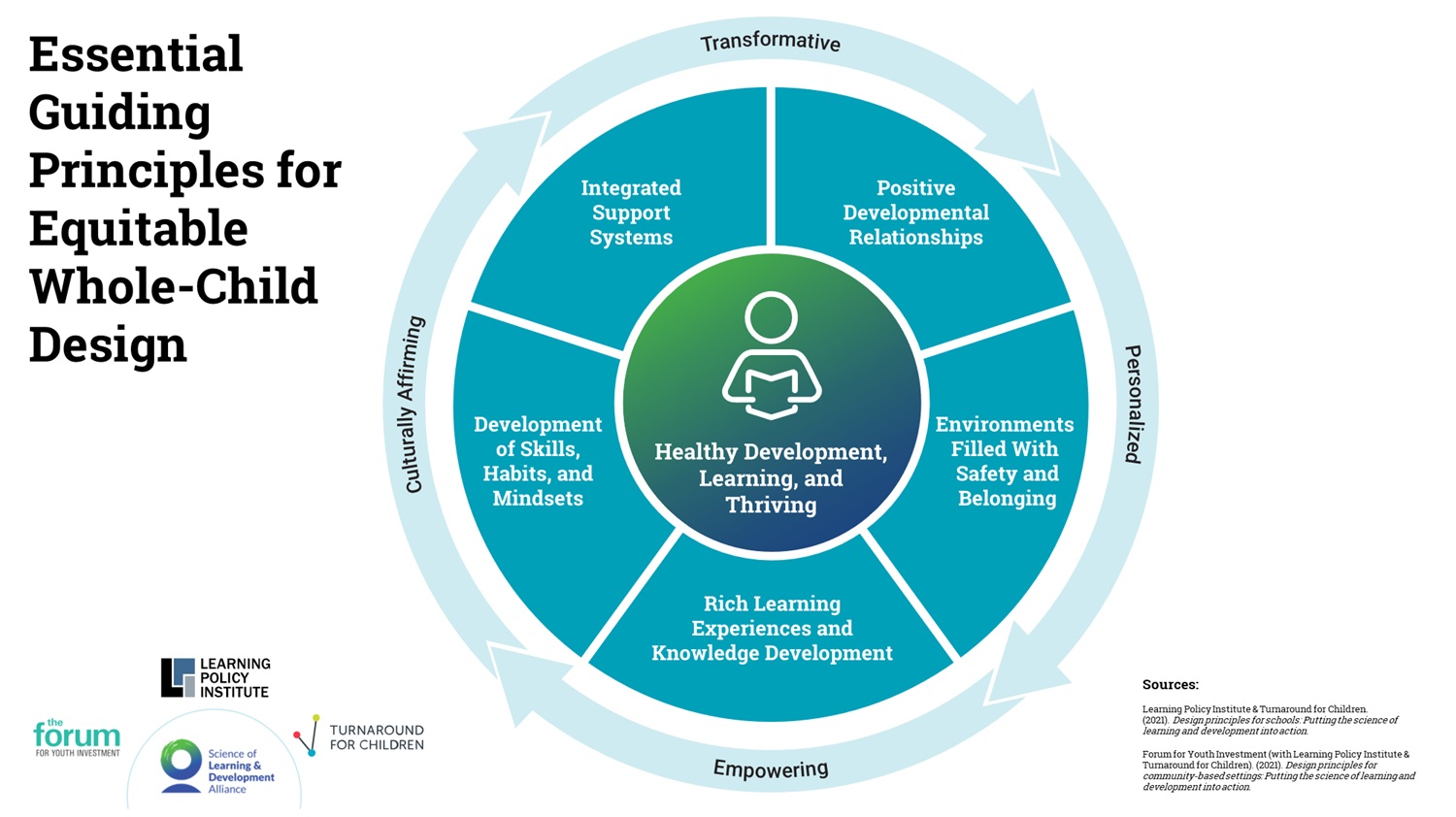
In our work, we refer to these principles as “the non-negotiables” to emphasize the fact that if one element is “in the red” the impact of the structured experience, no matter what the intent, will be compromised. The power of the blue wheel stems from the fact that it simultaneously depicts the solution and the problem.
Direct interactions with youth need to have all five elements at play to optimize impact. But the systems that train and hire staff to deliver interventions are designed to focus on only a few. This is not a criticism: Systems need to focus to be efficient. The challenge is not with what systems emphasize, but with what they minimize or ignore.
Schools, for example, are accountable primarily for knowledge development. Consequently, staff sometimes have trouble “fitting in” relationship building and social and emotional skill development. And they may overuse Tier II and Tier III wraparound support services that pull learners out of the classroom.
Community programs, on the other hand, often emphasize the other four elements, leading with mentoring, supportive club experiences, real life skills or crisis services. While learning is almost always a goal (e.g., building communication or self-regulation skills), they often downplay the academic learning embedded in their programming and miss opportunities to help youth tie these skills explicitly to their work in the classroom.
Both systems acknowledge — but for the most part rely on other systems to address — the basic challenges that are associated with poverty, violence and food, housing and safety insecurities. Osta’s column this week and Paige Swanstein’s column last week highlight the connection between youth mental health and broader insecurity issues.
According to Osta, “mental health … is a psychosocial, neurobiological process, not a predetermined fixed state, especially in adolescence. This means that we can improve adolescent mental health by investing in environments where young people experience safety and belonging, see value in their activities, and have systematic access to the resources they need.”
The YDSI study suggests that these supports not only contribute to mental health (which is still defined mostly by the presence of indicators of mental illness) but also contribute to positive development in ways that have a direct impact on young adults’ productivity, health and connection to community. Young people are incredibly resilient. The competencies young people have help determine their response to the circumstances and conditions they are presented with.
The Design Principles Playbook for Community-Based Settings includes a one-page reflection checklist to help practitioners and program administrators assess how central each of the five non-negotiables should be in their work. Opportunities to provide basic supports are last on the list but not last in importance. These stressors affect young people’s ability to take advantage of learning opportunities. Imagine what would be possible if young people also had the truly basic safety and wellness supports that YDSI and the SoLD Alliance both emphasize as foundational. How much more could we change the odds that all young people can thrive?
We encourage you to download the checklist and use it collaboratively with the young people you serve to get a sense of how important they think these elements are and how well they think they are being provided by someone in their ecosystem.
***
In her columns, Karen Pittman is exploring the research behind the statement, “When Youth Thrive, We All Thrive.”