

 In recent years, there has been growing attention to questions of youth trust, often framed around how institutions can rebuild relationships with young people. That shift is important. It also raises a deeper question about how trust flows in the other direction. We often ask:
How can we get young people to trust us?
It is a reasonable place to start. But it is also incomplete, because it allows us to avoid a more difficult question:
To what extent do we trust young people?

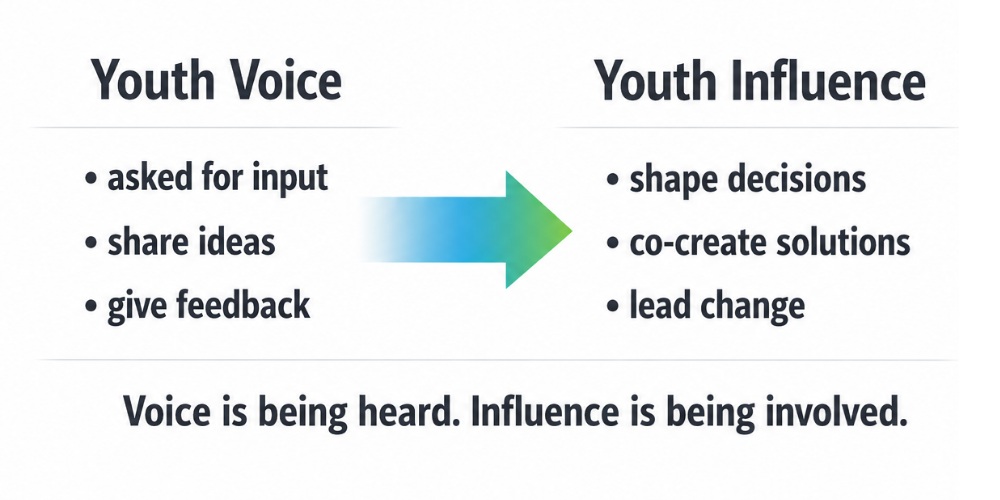
Across education, philanthropy and youth development, there has been real progress in elevating youth voice. Students are asked for feedback, included in advisory groups and invited to share their perspectives on issues that affect them. But in many settings, decision-making has not shifted at the same pace.
Young people are asked to contribute but are not consistently trusted to shape outcomes. They are included in conversations but less often in the choices that follow. Participation has expanded. Influence has not.
 That pattern is easy to miss from the adult perspective.
In many schools, student advisory councils meet regularly with administrators. Students are asked thoughtful questions, share honest feedback and are thanked for their input.
But when decisions are made — about schedules, policies, budgets — those same students are rarely in the room. Their role is to inform, not to decide.
As one student recently shared,
“We’re asked what we think, but we’re not part of what happens next.”
Systems can point to surveys, student groups and engagement strategies as evidence of progress.
Young people tend to measure something different. They pay attention to what happens after they speak, whether ideas are taken seriously, whether decisions change and whether the same small group of students is consistently trusted with leadership opportunities.
Those signals accumulate, and over time they shape how young people see their role in the systems around them. Participation can begin to feel procedural rather than meaningful. Engagement becomes selective. Leadership feels reserved rather than accessible.
At the same time, the field continues to wrestle with a familiar set of challenges: declining civic participation, uneven engagement in service, growing concerns about mental health and belonging, and persistent questions about how to prepare young people to contribute to complex systems. Significant resources are being directed toward these issues. New programs are developed. Campaigns are launched. Strategies are refined.
But many of these efforts share a similar starting point: They are designed for young people rather than with them.
The question underneath all of this is not simply how to engage youth more effectively. It is whether we are willing to trust them differently.
The Alliance for Youth Thriving has helped reframe how the field understands learning and development, emphasizing the importance of connected ecosystems across people, places, possibilities and systems. That framing highlights the importance of relationships and access. It also brings something else into focus: Ecosystems are shaped by how decisions are made, and trust plays a central role in those decisions.
Trust determines whether young people are positioned as participants or contributors.
It influences who has access to meaningful opportunities and whose perspectives carry weight. It shapes whether systems are experienced as responsive or predetermined. If we take that seriously, then trust is not a secondary value. It is part of the operating system.

Courtesy of Scott Ganske
Scott Ganske, vice president of education at Youth Service America
In early work with schools and youth networks, even simple efforts to surface how trust is experienced have revealed consistent patterns. Adults often point to the presence of opportunities. Young people focus on whether those opportunities lead to change. That gap is not a failure. It is a starting point.
The question is what we do with it.
In practice, the most effective next step has not been to add more opportunities for input but to identify where young people can play a meaningful role in shaping an outcome that matters. One decision. One initiative. One area where their contribution is not symbolic but consequential.
When that happens, the shift is noticeable. Engagement changes. Ownership increases. The relationship between young people and adults becomes more collaborative and less transactional. Trust becomes visible.
Trust can be revolutionary, as illustrated by the work of Ali Raza Khan, president and CEO of Youth Engagement Services (YES) Network Pakistan. “When you trust young people, they don’t just rise — they soar. And in doing so, they can change the world,” says Khan.
This does not require a new program or a complete redesign of existing systems. It requires a willingness to examine how decisions are made and to expand who is involved in making them.
The field has made important progress in elevating youth voice. That work should continue. But if we want to address the challenges we continue to name — from engagement to belonging to long-term participation — we have to look more closely at how trust operates within our systems.
Not just whether young people trust us, but whether we trust them enough to share responsibility for what happens next.
***
Scott Ganske is vice president of education for Youth Service America where, for more than 14 years, he has worked with hundreds of schools and community organizations, developing tools and trainings that truly integrate service with learning. He brings this approach to his volunteer role as youth and field engagement manager for Youth Today.