

 In a given year, a youth worker might complete state-mandated training, earn a social-emotional learning certification and log over 500 hours working directly with youth. They likely have a stack of certificates of completion, and maybe even an ‘Employee of the Month’ award. Yet, when they apply to college, none of their experience counts. This disconnect reveals a glaring flaw in our systems:
While youth work requires specific knowledge and develops essential skills, higher education controls the portable credentials
that lead to future jobs.
And the two systems are (usually) disconnected.
In the out-of-school time (OST) and youth development sectors, this gap is an equity issue. The OST workforce has historically been composed of entry-level and minimum-wage jobs filled predominantly by women and people of color, and by young adults just starting their careers (see: NY and CA examples).
The 2025 Power of Us Survey revealed that younger staff and staff of color typically do not yet have a college degree and are less likely to access and participate in professional development. Furthermore, front-line jobs do not pay family-sustaining wages, making career pathways essential to enable staff to climb the ladder into full-time youth development, education, social work or nonprofit management jobs. When a worker’s time and energy are tied up in mandated training requirements, they have less capacity to pursue a college certificate or degree — still required for most thriving-wage jobs.
[Related: Workforce readiness should start before college]
One solution lies in Credit for Prior Learning (CPL): a strategy that bridges this gap through credit equivalencies, portfolio reviews and articulation agreements. According to the Council for Adult and Experiential Learning (CAEL), “Credit for prior learning isn’t new — colleges and universities have used it for more than 50 years to award college credit for what incoming students already know. Yet CPL is underutilized in higher education, particularly given its powerful benefits.” Ideally, professional development operates at the center of a Venn diagram: training completed on work time and paid for by the employer that 1) meets licensing/funder requirements, 2) addresses program quality and positive youth development and 3) translates into college credits for the individual youth worker.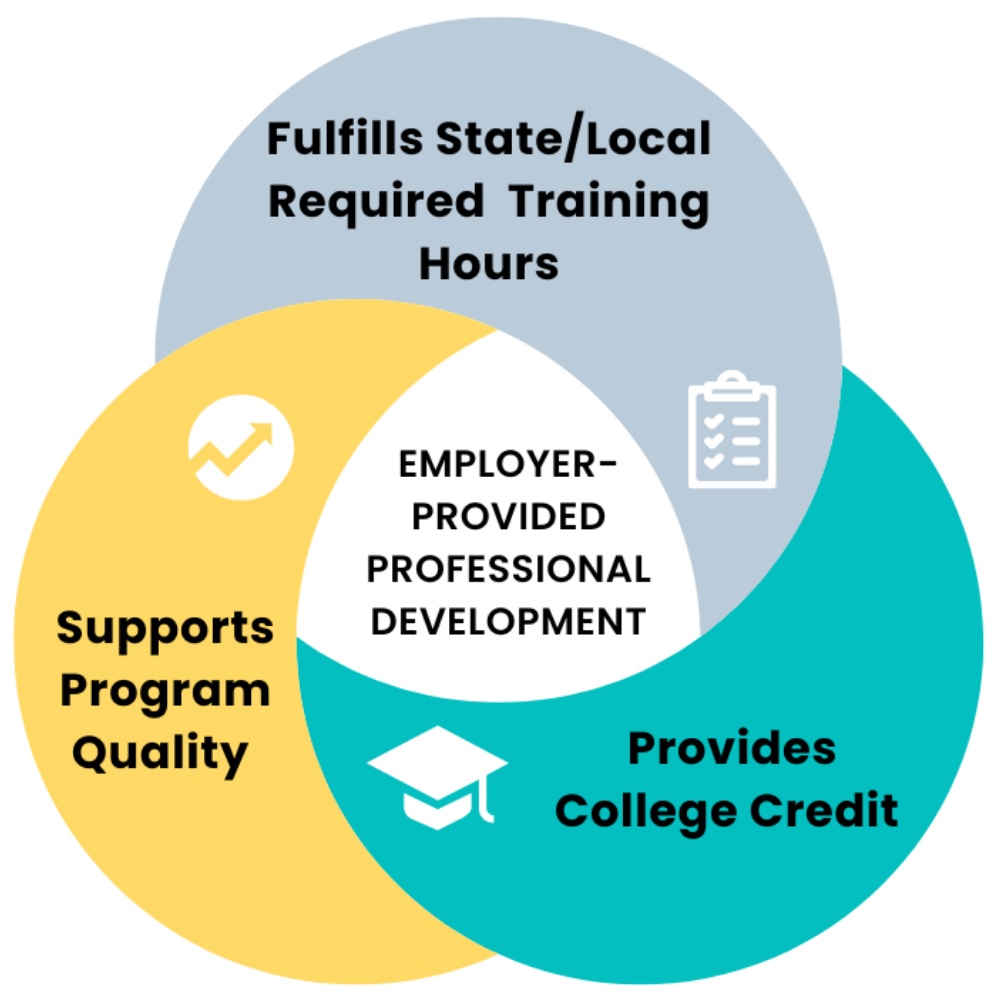
CPL is a structural equity intervention.
It reduces the duplication of learning, lowers tuition costs and accelerates the time it takes to earn a degree. CAEL’s research suggests marginalized students who receive credit for prior learning earn degrees faster and more frequently than their peers who do not.
My own work at Change Impact has shown that CPL partnerships can be an effective strategy to support youth workers. We partnered with the City University of New York (CUNY) to align a series of our self-paced trainings on our Change Up Learning platform with college course requirements. CUNY faculty reviewed our learning objectives and content to ensure rigorous alignment with their coursework. Because our courses are also approved by New York State to count toward training hours required through state regulations, staff are able to earn college credit and fulfill mandated training requirements simultaneously.
Alyssa Vine, CUNY University Director of Credit for Prior Learning, said, “CUNY welcomes working adults into our colleges with recognition that their workplace experience and training are meaningful in the college classroom. We are thrilled to create pathways into degree programs for youth development workers.”
And, many youth workers have benefited. Gus Cruz, a youth worker taking classes at night to pursue his degree, said, “Earning credit through CPL allowed me to accelerate my degree at CUNY School of Professional Studies while learning valuable skills highly relevant to my job. The money I saved on tuition was a big help, too.”
[Related: They age out — then we hire them. What happens next matters most.]
CPL comes with some concerns, like a potential loss of tuition revenue for higher education. However, CPL also significantly reduces barriers to enrollment, and universities don’t collect any tuition from students who never enroll in the first place.

Courtesy of Jen Curry
Jen Curry
Some critics have also noted that CPL does not always transfer between schools or from community college to four-year institutions, but it seems university systems are finding ways to solve this challenge. For example, at CUNY, prior learning is evaluated as formal academic credit transferable across CUNY campuses, which helps reduce credit loss for students who move between institutions.
Finally, whereas some employers might view CPL as a way to encourage staff to leave their jobs, I prefer to view it as an employment benefit that will attract and retain youth workers for longer. (See my previous article on rethinking turnover for more.)
Next steps? Youth development leaders and intermediaries can engage local higher education partners to see what might be possible. Trainers can and should think about how to align their offerings to general education requirements and can also reach out to local colleges to find out how to secure credit for their trainings.
Ultimately, enacting Credit for Prior Learning is a recognition of professional dignity. CPL provides options to workers — college may not be for everyone, but everyone should have the opportunity, and CPL mitigates barriers.
When we recognize youth workers’ experiential knowledge, we affirm their work
is valuable, rigorous and worthy of academic acknowledgment.
***
This piece is the latest in the Thriving Youth Need a Thriving Workforce Series. Previous pieces:
A restorative approach to professional development for youth workers
College students can help close the gap between demand and availability for afterschool programs
From turnover to graduation: Rethinking staff retention | Investing in the OST workforce: Dreaming big and starting small
Jen Curry, Ed.D., is CEO and founder of Change Impact, a capacity-enhancing organization working with nonprofits, schools and systems to achieve results and advance equity for youth.