


If you are nervous about this year’s fundraising goal, you are not alone. Goal setting in fundraising can intimidate even the most seasoned leaders.
How do you really know if your fundraising goal is achievable? Let’s step through three truths and create a gift chart to determine what it takes to achieve a fundraising goal.
1. Fundraising potential is tied to engagement
A realistic fundraising goal considers not only the financial aspect of the goal, but also the investment of time and effort to engage the community.
Many leaders make the mistake of thinking fundraising is about money and focus solely on projecting the total income needed. They forget to consider the work involved or the investment needed to achieve it.
Fundraising income is the direct result of a nonprofit team’s coordinated efforts to engage the community in the mission work. The better you connect with people who care about your cause, the more resources will flow to your mission.
How do we calculate the number of people we need to engage in order to achieve the fundraising goal? This brings us to our next truth.
2. Every gift requires three to five quality engagements

Courtesy of Janeal Ford
Janeal Ford is the president and CEO of Fordable Fundraising
Let’s assume a charity sets a goal to raise $500,000 for the year. To determine the number of people we need to engage, we assume that for every gift, we need to identify, cultivate and solicit 3 to 5 people.
This is a general guideline and assumes we hear “no” about 80% of the time.
For example, if we identify five local foundations and prepare and send them all grant applications without making any connection, odds are one might make an award.
If, instead, we take the time to engage with foundation’s leaders, to listen to their interests and to introduce the project, the odds of being awarded a grant improve dramatically.
Fundraising success results from intentional connection with prospective supporters.
3. The majority of a non-profit’s income comes from a few donors
Now, before we can chart out the community engagement work, we need to factor in the 80/20 rule.
The Pareto Principle, more commonly known as the 80/20 rule, was named after economist Vilfredo Pareto who pointed out a unique recurring pattern: just 20% of input generates 80% of output.
I have evaluated giving data from numerous organizations, and this pattern is present most of the time. In short, we can expect the majority of our $500,000 to come from a minority of donors.
Charting it out
We are now ready to create a gift chart to evaluate what it will really take to achieve our $500,000 fundraising goal.
Gift charts are a fundraising tool to help us see the real work involved in fundraising. It incorporates the assumptions we just discussed: Three to 5 prospects are needed for any one gift, and 80% of giving will come from 20% of prospects.
Using these assumptions, I created a gift chart. To make life easier, I used this free online gift chart calculator as a tool to help us with the calculations.
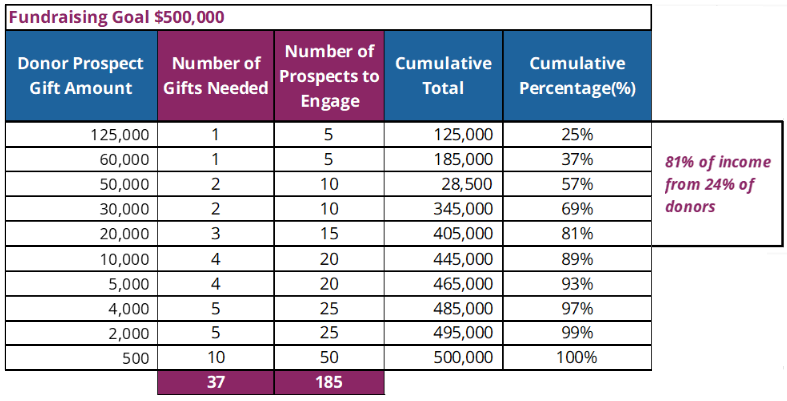 Based on the results of the chart, over the next year, we will need to cultivate and solicit gifts from 185 people.
Among this group of prospective donors, we need approximately 45 people who can make a gift of $20,000 or more.
Now that we have created the gift chart and can see the relationship work involved, we can evaluate if the charity has the bandwidth to achieve this level of engagement.
If not, we need to consider reducing the goal or increasing the investment in fundraising.
Janeal Ford is the president and CEO of Fordable Fundraising and has served in the nonprofit sector for more than 20 years. As a fundraising professional, board member, community volunteer and consultant, she has helped charities raise millions of dollars. Ford received a Bachelor of Science in Sociology and a Master of Public Administration from the University of Utah and is a Certified Fund-Raising Executive.