

Even when pressed for talent, many employers are choosing to pass on entry-level candidates. In a 2024 survey, 98% of business leaders said their organizations struggle to find talent, yet 89% avoid recruiting recent graduates. One of the top reasons cited was that these recent graduates don’t know how to work well on a team. These stats aren’t meant to scare students, but they should be a wake-up call for educators, parents, business leaders and organizations serving our youth.
This gap matters, because as AI takes on the routine work, our human value will increasingly be measured by our ability to coordinate with others to solve novel challenges. Anne Jones, District C co-founder, and I stepped up to meet this need eight years ago by launching District C’s Teamship program — an in-school, reimagined internship where teams of students tackle live business challenges. Since then, more than 9,000 middle school, high school and college students have developed solutions ranging from boosting employee engagement for a software firm to helping a city crack down on illegal waste dumping.
Here are four ways a reimagined internship like Teamship helps equip students — and their teachers — for the future of work:
Teaching students the power of the collective.
Diverse teams outperform homogeneous ones but only if team members know how to leverage the diverse perspectives of others. In Teamship, students learn to do just that. Take Lamont, a high school junior who worked with peers to help a tech company improve its public relations. Once a self-described loner, Lamont learned to ask probing questions of his teammates and synthesize different points of view.
“It’s really helped how I cooperate with people, and it’s been a major factor in building my character and who I am today,” Lamont said after Teamship.
Helping students explore their interests.
Work-based learning has proven to be a powerful model for career exploration, particularly for students participating in programs like Teamship in high school. These models offer students the opportunity to test the waters without having to commit to a specific career field or major like in college. Because Teamship problems come from a range of partners like Snapchat, IBM and even the U.S. Patent & Trademark Office, students get the opportunity to sample fields across the spectrum, including hospitality, media, health tech, finance, marketing and many others.

Courtesy of Dan Gonzelez
Dan Gonzelez
Pairing students with an expert coach.
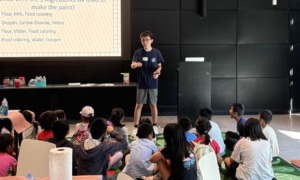
Putting students in teams and asking them to solve a problem is the easy part; helping them get better at the work is the art. That’s the role of the Teamship coach. Every Teamship team works with a certified coach, often a classroom teacher who has completed our intensive training and certification pathway. In Teamship, coaching is fundamentally different from traditional teaching. A coach manages the learning experience, not a preset curriculum, guiding students through the problem-solving process instead of lecturing on content. When teachers shift from answer‑giver to coach, the culture of the work tilts toward collaboration and student ownership.
Removing the usual internship barriers.
According to an American Student Assistance survey, transportation and scheduling are often obstacles to student participation in internships. Because Teamship happens at school (or on campus) during the school day, it puts real work experience and the opportunity to practice team-based problem-solving within equitable reach of those who typically miss out.
What now?
If we want to provide broader access to these kinds of opportunities, we need a community effort. Youth-serving organizations are uniquely positioned to help. Here’s how:
- Join our growing network: Become a District C business partner and offer up a pressing problem for student teams to solve. Without authentic problems represented by real professionals, this work doesn’t happen.
- Engage the community. Help local business leaders see their stake, not just as consumers of talent but as active participants in developing talent. Start conversations about how they too can offer problems for Teamship work.
- Encourage young people to stretch. Traditional school often celebrates individual achievement, yet the first rule of real work is that your value is measured by the contribution you make with and for others — your teammates, supervisors and customers. Encourage the young people in your life to seek out experiences — Teamship or otherwise — that push them to collaborate and add tangible value to someone else’s mission.
The future of work belongs to those who know how to coordinate with others to do hard things. Let’s help our young people get ready.
***
Dan Gonzalez is the CEO and co-founder of District C, national nonprofit reimagining the internship experience and preparing the next generation of diverse talent for modern work. Through District C’s signature program Teamship, teams of students solve real problems for real businesses, learning to collaborate and problem-solve like professionals.