
I fled an arranged marriage to be LGBTQ in the U.S., but I wasn’t safe from ICE.
So I fled again, to Canada.

My journey from West Africa to the U.S. took me away from everything I knew, but brought me closer to what I wanted to be: free. I arrived in May 2024, and it seemed at first that I could build a new life in New York City. I went from a shelter to a foster home and then to a better foster home. I made connections at school, on the soccer field, with my friends and my therapist. I wrote down my thoughts to help me understand my emotions, so as not to be overwhelmed by them. I came out as LGBTQ and focused on my education.
But the fear never truly disappeared. The sounds of sirens or police cars made my heart race, even before Donald Trump became president again that November. Trump promised to deport 11 million people as he campaigned. Every video on social media, every announcement about mass deportation brought me back to that paralyzing dread: What if my name was on that list?
Adults around me reassured me: “You’re a minor, you have a strong case”; and “New York doesn’t collaborate directly with the federal government”; and “ICE isn’t allowed to go everywhere.” These words calmed the fear, but they didn’t erase it.
In the fall of 2024, before the election, my English teacher, Ms. B., noticed my mental absences and constant fatigue. “What’s going on?” she asked me gently one afternoon. My voice trembling, I told her about leaving my country and the growing fear and insecurity I felt as a refugee. We shared that we both had depression, and she told me that she was adopted. She listened, without judgment.
When the class came back together, she told everyone that New York protected immigrants. “Your information is confidential; you are not alone,” she repeated.
[Related: The empty desk — A student’s view of the siege in our hallways]
Soon after Trump was elected, I went to the soccer field to escape the stress. There, I met a boy a little older than me, and we started talking.
He was from Africa too. He asked me how long I had been in the United States, how I found life here, if it was difficult. I trusted him, maybe because he looked at me with sincerity, without pity or morbid curiosity.
I talked to him a little about my situation, my studies, and the fear I felt every day. And he told me he had come to New York almost the same way as me, without papers, without a place to go. He was thinking of leaving the country—maybe for Canada—because of what ICE was doing to people like us.
I said, almost without thinking, “Me too. If things continue like this, I’d like to leave.”
He shook his head gently. “No, you’re still a minor. It makes a difference. You can be protected. If your lawyer works well on your case, the United States can offer you many things. Don’t rush.”
I smiled, a little bitterly. He was saying what others kept telling me, but the news told a different story.
We exchanged contacts, and in the following months, we communicated occasionally. It wasn’t a deep friendship, but it was a silent understanding between two young people who carried the same scars.
Plunged Back Into Fear
As soon as Trump took office in January 2025, the situation became urgent. In cities across the country, ICE carried out raids and mass arrests. More than 3,500 people were arrested in the first week of the new administration—at their homes, workplaces, churches, and mosques. Images and videos circulated on social media: masked agents grabbing people, families separated, and protests erupting over it all.
Reading the news and seeing the videos, I felt the danger touch my own life. Even if my case seemed strong, even if my therapist, my lawyer, and the social workers reassured me, the reality was that I wasn’t truly safe.
My foster mom didn’t understand my distress. “Why do you always look so down? You are safe here, you have nothing to fear,” she told me. I tried to explain to her: “If I stay, I risk being arrested … or worse. My future could be destroyed.” She shrugged, as if I was expressing a teenage whim.
I felt isolated, and the fear of deportation prevented me from concentrating on school or sleeping at night. I communicated with one brother back home and learned that my little sister had been engaged to marry an older man. She was only 13. I felt guilt that perhaps my parents did this because I ran away from the marriage they arranged for me when I was 14. I also felt fear that if I were deported back to Africa, they could do the same to me, as I was only 16.
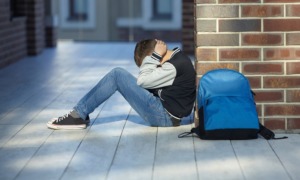
Every time I walked out the door, I thought, “Will I come back tonight?”
The fear of disappearing without anyone knowing where I was followed me everywhere: at school, on the bus, in the street.
My foster care agency didn’t connect me with an immigration lawyer when I first went into care. (Every foster child in New York has a foster care lawyer, but refugees need a separate immigration lawyer.) So my process to get asylum didn’t even begin until March 2025. They told me I had a court date in 2026. This felt far too slow given what ICE was doing in the U.S.—plus immigrants were being snatched and detained when they showed up for their court hearings. In June 2025, the U.S. took away SJIS, which used to protect foster youth who were in the process of getting their green cards.
Writing Clarifies and Empowers
Soon after my asylum process began, I applied to join a six-week writing program at Youth Communication. When I arrived in July, everything seemed new to me: the computers, the calm atmosphere, people who listened to you without judging you. I started writing, timidly at first, with my English mistakes, my hesitations, and some memories that I still couldn’t confront. But little by little, the words started to come. My editor didn’t speak French, so we worked via translation apps.
[Related: Never too young to be an advocate]
Writing about my journey from Africa to the U.S. forced me to revisit everything I was trying to forget. Writing forced me to feel again, to recognize my fear, my fatigue, my fragility. I was pretending to be calm, but I was always on alert.
Writing also made me look at my life head-on and helped me see that the safety people were promising me was an illusion. Constructing a narrative about my harrowing journey from Africa to Colombia, through Central America, Mexico, and into the U.S. gave me clarity. My life didn’t depend on what I had been promised, but on what I decided to do myself.
Reading the news in July and August confirmed the danger I was in. That’s when I started thinking seriously about Canada. I knew it would be risky, but everything I had been through prepared me for this decision. I started talking more with the boy from the soccer field. He told me that he and the other boys were going to leave for Canada soon.
A few days later, on August 11, 2025, ICE arrested a 7-year-old girl at 26 Federal Plaza, the New York City building where many migrants go to renew their documents. The girl and her mother were sent to Texas, leaving behind her 19-year-old brother. This arrest was widely covered by the media and provoked protests and demands to return those arrested by elected officials in New York.
My mind kept returning to that little girl and her family. No one was safe.
Fleeing Again
Late in the summer, I called the boy from the soccer field. To my surprise, he told me that he and some other boys from Africa planned to leave the next day.
I felt a shiver run through me: Everything was becoming real. He told me to think, to really think if I was sure and then to call him. That night, every noise outside made me jump. I called him back and said, “Yes, I plan to leave.”
He gave me simple instructions: “Don’t tell anyone. Just prepare a backpack. Tomorrow, I’ll tell you when to leave.”
I felt both scared and strangely liberated. The fear was immense, but for the first time in months, I felt I was regaining some control over my life. I packed my backpack with my soccer trophies and medals, a pair of pants, a t-shirt, a pair of shoes, my toothbrush, some essential documents, and a book my editor gave me: Inferno (A Poet’s Novel) by Eileen Myles. I was sad to leave my soccer ball.
It was hard to sleep. I woke up several times, each time with a lump in my throat, thinking about everything that could go wrong. My foster mom had told me once that if I wanted to leave, she would talk to the agency, but I was afraid they would prevent me from leaving. So I told nobody.
My body and my mind are regaining a human rhythm, that of a person who has the right to exist without fear.
The wind that last day was warm and heavy, as if it wanted to hold me back. I went to the hospital with my foster mom and got my Covid vaccine. After we got home, she asked to try my bike—it was strange, she had never done that before. I filmed her with her phone while she rode, laughing.
I looked at the house, the dog they had just adopted, my foster sister and her boyfriend. I knew it was the last time I was seeing all of this. But I couldn’t cry, or even say goodbye.
My foster mom gave me back my bike, and I told her that I was going to visit my friend. I gave her a long, strong hug, feeling a mixture of gratitude, fear, and sadness.
I put on my hijab, which I’d stopped wearing in New York. I rode my bike through the Bronx to the subway carrying the heavy backpack and feeling tired from the vaccine. From the subway, carrying my bike, I took a bus, then another. I changed direction, again and again, so no one could follow me. I turned off and disabled my phone.
When I joined the boys in New Jersey, it was still daytime. There were five of them, and I was the only girl. I didn’t know all of them, but I trusted the one who had promised I would be safe. We got in a big black car with someone; I didn’t know if he was an Uber driver or their friend. I left my bike in New Jersey. They gave me the front seat and we drove in silence, no music. It was not a vacation.
After about 12 hours in the car, the driver dropped us off near the border. One of the boys said, “Now we walk,” and I followed. We walked in single file through the darkness, first one young man, then me, then the others. We walked through tall, wet grass, then along train tracks. The silence around us was heavy, broken only by the sound of our steps on the wet ground. When a train came, we ran away from the tracks and hid in the grass.
I didn’t know where I was going. I followed their shadows. I told myself, “You’ve survived worse. Keep going.” And then, one of the boys said, “We’re in Canada.” There was no barrier, no visible border, and the same moonless sky.
Another car came and picked us up. The driver took addresses from the others. He asked me if I had anyone here.
I replied: “No.” He then drove us to a mosque and left me there just before dawn. The door was open, and I put on a Covid mask over my hijab and walked in. I told the imam I didn’t have anyplace to go, and he told me there were other people from my country there. He introduced me to a man from my country, who took me to his home where he lived with his wife and daughter.
They put me in a spare room and I took a shower, then turned my phone back on. There were many messages from my foster mom, and I called her and told her I’d left the country. We both cried; I apologized, and she told me I was welcome back. But I knew I couldn’t go back.
Another New Beginning
I don’t yet know what Canada will decide for me. When I was in New York, at the beginning, everything seemed fine—before the system abruptly changed. I don’t know if Canada will also change its way of treating immigrants. But for now, this country is not like the U.S. And that gives me a little courage.
The fear hasn’t completely left me. Everything is happening so fast that my brain and my heart haven’t had time to catch up. Even though I mostly feel safe now, trauma itself doesn’t disappear overnight. I’ve had nightmares, sleeplessness, fear, and depression since I arrived a few months ago.
But I push forward. I started school, found a temporary place to live, found a doctor and therapist, and an immigration lawyer. I also opened up to the new people here who are helping me, cautiously. The boy from the soccer field sometimes sends me messages, just to make sure I am safe. I am still a writer at Youth Communication, long-distance.
These connections help me feel less alone. Little by little, writing became my lifeline again. Transforming my memories and new experiences into text gave me some strength. Absent the daily fear I felt in New York, I can reflect and reconstruct. My body and my mind are regaining a human rhythm, that of a person who has the right to exist without fear.
***
This story originally appeared in Represent, published by Youth Communication.
The author is a girl from Africa who is writing her autobiography. She also plays soccer, writes music, and is interested in acting.