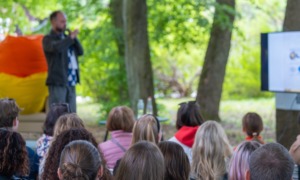


I’ve worked with teenagers for most of my adult life. In classrooms. At camps. In afterschool programs. Sitting in folding chairs in rooms that smelled like gym floors and stale pizza.
For a long time, I thought the goal was control. If things got loud, I tightened the rules. If behavior slipped, I raised my voice. If a kid pushed back, I pushed harder.
The room got quieter. Kids stayed in their seats. But nothing changed.
What I didn’t realize was this simple truth: You can’t correct a kid into leadership.
Decades of youth development research confirm this. Adolescents develop leadership, agency and resilience not through control, but through environments that support autonomy, belonging and skill-building.
Why corrections don’t stick
Most adults don’t correct kids because they’re angry. We correct because we care. We want safety. Structure. Better choices.
But correction usually teaches one lesson: Don’t get caught next time.
It doesn’t teach decision-making. It doesn’t build confidence. And it almost never strengthens a relationship.
[Related: From relationships to opportunities — What we learned about social capital mobilization]
If you’ve spent time with adolescents, you’ve seen it. The kid who shuts down. The one who nods yes and repeats the same behavior tomorrow.
Research backs this up. The positive youth development framework, particularly the Five Cs model, shows that young people thrive when programs intentionally build competence, confidence, connection, character and caring rather than focusing primarily on behavior control. Similarly, Self-Determination Theory demonstrates that autonomy, competence and relatedness are core psychological needs. When those needs are supported, motivation and engagement increase. When they are suppressed through excessive control, motivation drops quickly.
But you don’t need a study to know this. You’ve lived it.
A moment that changed how I show up

Courtesy of James McLamb
James McLamb
One summer working with a group of teens at a leadership camp, one kid — I’ll call him Jordan — stood out immediately. He wasn’t rude. He wasn’t disruptive. He just wasn’t buying what we were selling.
Early on, I would have corrected that. Asked him to participate. Explained why engagement mattered.
Instead, one of our coaches did something different.
He walked next to Jordan during a break and said, “You’ve got a presence. People notice you. What do you want out of this week?”
That was it. No lecture. No warning. Just a question.
And slowly, things changed.
Jordan tried a group challenge he was sure he’d fail. He didn’t. He helped demonstrate a skill without being asked. His group chose him to speak for them. He stepped in during a tense moment and helped calm things down. On the final night, he encouraged a younger camper who was struggling.
What I watched unfold was the Five Cs of positive youth development in real time. Competence. Confidence. Connection. Character. Caring.
None of it came from correction. All of it came from coaching.
I’ve seen versions of that same story play out in schools, afterschool programs and juvenile justice settings. Different kids. Different spaces. Same result.
When young people feel coached instead of controlled, they rise.
Three coaching shifts that actually work
Today, through Generation Youth, I spend most of my time helping educators, coaches and youth workers rethink how they respond in everyday moments with kids. The work is practical and relational, focused on building mindsets, strengthening self-image and helping young people develop real leadership from the inside out, not just short-term compliance.
That’s why I believe you don’t need a new program or a complex framework to coach young people better. You need a mindset shift and a few habits you can use tomorrow.
First, get curious before you get corrective. There is always something underneath the behavior. Always. A calm “What’s going on?” lowers defenses and opens the door to honesty. Curiosity builds trust, and trust creates space for growth.
Second, ask before you answer. Some move too quickly to advice. Slow it down. Ask questions like: What were you hoping would happen? What options did you see? What would you try differently next time? Research on autonomy-supportive teaching shows that when adults ask questions that invite perspective and choice, youth engagement and persistence increase.
Third, plan forward together. Correction often ends with “Don’t do that again.” Coaching ends with “What’s your next step, and how can I help?” When young people help shape the plan, they take ownership of the outcome.
These shifts are not soft. They are effective. They build internal motivation instead of surface-level compliance.
Across education, out-of-school time, child welfare and juvenile justice, there is a growing recognition that managing behavior is not enough. We need approaches that build internal motivation, emotional strength and leadership capacity.
Coaching does that. Correction doesn’t.
Young people don’t need more adults pointing out what they did wrong.
They need adults willing to listen, ask better questions and see strengths that are not obvious yet.
If we want a generation ready to lead, then the way we show up for them has to change. For youth-serving professionals, the shift starts small. Audit the moments where correction is your default. Train staff in coaching questions, not just behavior management. Build supervision and program models that reward relationship-building, not just compliance.
I’ve seen what happens when we make that shift. It changes kids, relationships, and, over time, it changes entire programs and communities.
That’s not theory. That’s experience. If we are serious about preparing young people to lead, then our systems must reflect that goal. Policies, training and accountability measures should prioritize youth voice, autonomy and relationship-centered practice across the entire youth development ecosystem.
***
James McLamb is a national youth empowerment strategist, speaker and founder of Generation Youth. You can contact him at james@generationziglar.com.