
“Learning ecosystems may be found anywhere, but it takes careful stewardship to help them thrive.”
 We circle back to this quote from Remake Learning regularly in our efforts to make the mission and strategies of the Alliance for Youth Thriving more concrete. Each rotation gets us a bit closer to answering two questions:
Is ecosystem stewardship different from systems leadership? If so, what does an out-of-school time (OST) intermediary do?
The answer to the first question is yes. The answer to the second is system building. However, in many cases because of the flexible, boundary-spanning mode in which they operate, they may be positioned to take on a broader role in stewarding the full learning ecosystem.

What is the learning ecosystem?
The term learning ecosystem has become commonplace among school leaders. It signals their recognition of the fact that families routinely look for and find enriching, meaningful learning experiences outside of school. Equally important, it captures the fact that everyone – youth, families, community, civic and business leaders – wants schools to find ways to infuse more real-life skill-building experiences into the school day and give learners credit for learning that happens beyond their purview.
[Related: An invitation to learn, reflect and act together for equity-centered thriving]
 Quoting again from Remake Learning:
“The learning ecosystem is not a replacement for schools. Instead, it’s a ‘both/and’ vision – one that embraces all that schools can be by tending to the vital lifelines that link schools to the rest of life.”
“Shifting our thinking can shift our reality. By broadening our view of education to include the entire learning ecosystem, we can unlock the limitless potential for learning inherent in our communities.
The colorful icon graphic created by the National League of Cities and the Afterschool Alliance during the pandemic to remind education and civic leaders of the places beyond schools is a powerful visual representation of the “limitless potential” for learning in communities that can emerge if connections between the people — the youth and staff – in these places can be optimized. The reality, however, is that these connections are not only far from optimal but are also extremely inequitable.
The graphic contains the answer to the question of whether OST intermediaries are system builders or stewards: Youth programs is just one of 10 icons whose staff and programming contribute to the 3600 | 365 | Up to Age 25 learning ecosystem the Alliance for Youth Thriving promotes.
OST intermediaries as system builders
OST intermediaries are developing systems to coordinate efforts and resources for local afterschool and summer learning nonprofits. Nonprofit organizations offering programming in the afterschool and summer hours have been around as long as schools have. But intentional efforts to build systems to coordinate activities and resources only began a few decades ago, catalyzed in large part with funding and leadership from the Wallace Foundation.
Successful OST system leaders share many characteristics with ecosystem stewards. They tend to be entrepreneurial boundary-spanners who lead with trust-building, emphasize collaboration and look for innovative, adaptive solutions to their members’ challenges. And they and the organizational structures they build are managed very differently from the centralized structures of traditional schools. These traits make OST system leaders prime candidates for becoming ecosystem stewards, or at least for sharing this responsibility. But there is a difference.
Ecosystem stewards cultivate connections across systems
Ecosystem stewards find ways to weave across the people, places, and possibilities where young people spend their time, helping to cultivate the web of relationships that directly shape young people’s daily experiences. Ecosystem stewards strive to work with school, youth development and workforce leaders to build vibrant, equitable learning ecosystems where every connection is optimized. They often create or evolve purpose-built intermediaries that work closely with key partners to increase access to high-quality learning experiences for whomever it is most needed. They create or adapt tools and trainings to accelerate the spread and ensure the uptake of powerful learning goals, practices and experiences across settings and systems.
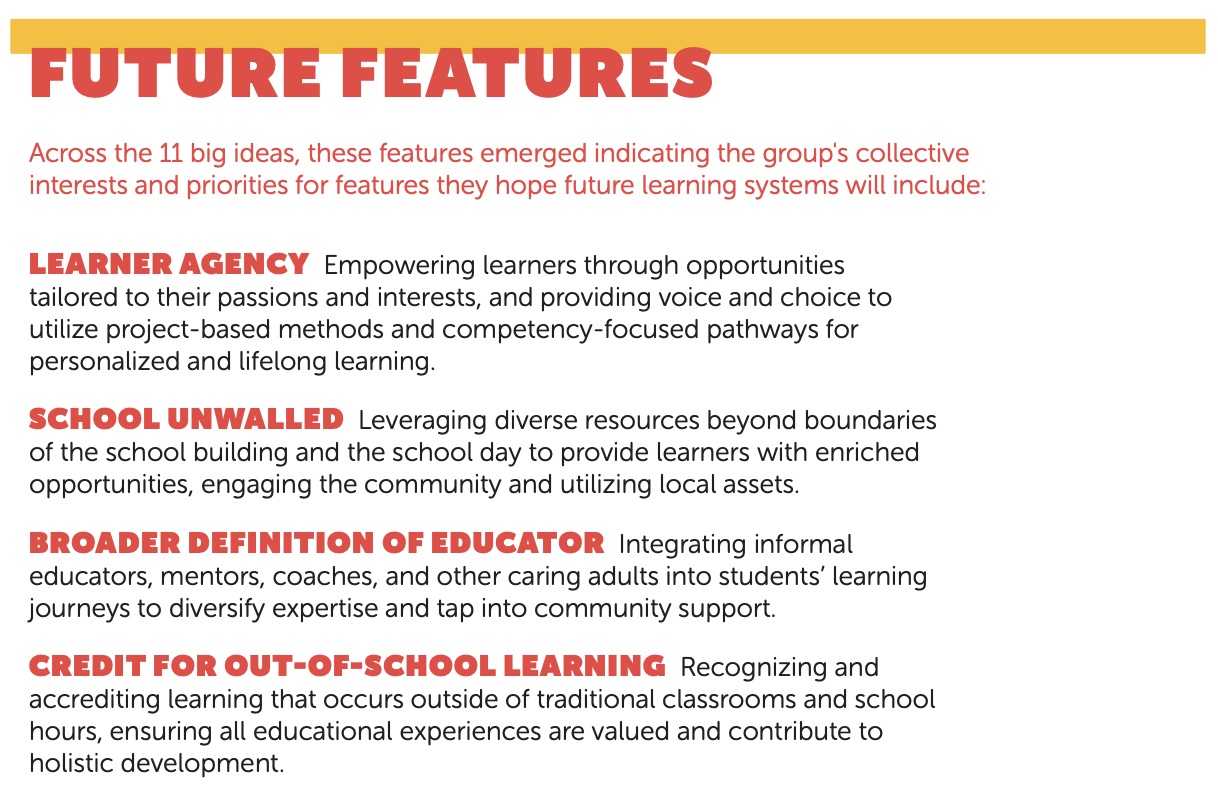
Remake Learning commissioned us — as managing partners of the Alliance for Youth Thriving — to develop case stories of four communities that have made strides in promoting the Future Features identified in the 2024 Forging Futures convening co-sponsored with AASA.
We opted to profile four mature, purpose-built ecosystem intermediaries that shared the following characteristics:
- Focus on improving the design and availability of learning experiences and pathways across systems and throughout the community, contributing to the development of critical skills and competencies needed for young people to be productive, healthy and connected.
- Actively work to partner with and create opportunities for educators in their school districts and broader communities to expand access to learning experiences built around the Future Features in school and community.
- Commit to ensuring that teens farthest from opportunity are future-ready, with the competencies, connections and experiences needed to thrive in work, learning, and life.
- Develop system-level solutions and network structures that have been or could be leveraged by K-12 and/or adapted or adopted by other communities.
- Design or adapt tools, technologies and training that can be packaged for use by others and are part of larger networks that support knowledge transfer of best practices across learning systems focused on academic, social/emotional/civic or workforce readiness development.
- Adopt or develop measures of learner, educator and community impact that can complement traditional accountability or impact measures.
The leaders selected different starting points for forging connections for real-world learning in their communities.
CommunityShare emboldened teachers to develop community-facing projects by matching them with community experts through an online platform — bringing meaning to their school courses that created formidable bonds beyond the school building and school day, measuring impact and documenting their stories.
The PAST Foundation engaged business and industry leaders to develop real-world projects and programs for and with students as part of a vibrant STEM ecosystem supported by an innovation hub. First engaging learners and educators in the afterschool and summer hours, they recently added industry fellowships for teachers and portable innovation labs that can be parked at schools for teachers to use.
The Providence After School Alliance (PASA) challenged community-based program providers to fill the void in interest-driven skill-building after-school and summer activities for teens on school campuses to maximize opportunities for alignment with school staff and curricula. PASA partnered with workforce boards to provide young people with greater access to jobs for OST learning and with the Department of Education to design Rhode Island’s All Course Network.
Heart of Oregon Corps engages 16- to 24-year-olds directly, challenging those sidelined by public systems to work, learn, earn and lead by creating a model rooted in belonging and real work where youth leaving the justice system, navigating poverty or recoiling from school failure join work crews to build confidence, build skills, connections and credentials while responding to real community problems. They have built a regional workforce development and learning ecosystem that connects youth, employers, schools, public land agencies, community colleges and community-based partners through layered pathways.
These ecosystem intermediaries found ways to embed the Future Features at all levels (from practice to policy) using language that resonates across systems and settings to improve the experiences of all learners regardless of where they are enrolled or neighborhoods where they live by:
- Promoting Learner Agency throughout the community by directly creating opportunities for youth to have more control over what, when, with whom and how they learned, focusing on real-world opportunities for building competencies and connections that matter.
- Institutionalizing the principles behind School Unwalled by developing strategies and systems that make it easier for partners and resources beyond the school building, day and year to contribute and connect to consistent (versus ad hoc) opportunities to learn, lead, and earn credit or wages, creating more visible and varied learning pathways.
- Operationalizing a Broader Definition of Educator by developing informal and formal opportunities for educators, mentors and coaches in school and community organizations to not only be recognized and supported but have opportunities to work together across system boundaries, filling time and space in and beyond the school day and year.
- Normalizing the idea of getting Credit for Out-of-School Learning by creating sustainable paths for teachers to find partners to take learner projects into the community; engaging industry, business and city services leaders to co-design competency-building learning and work experiences with youth that lead to industry credentials; or developing quality standards and enriched program content to help out-of-school time program providers engage teens in interest-driven learning linked to school credits.
System building is important. Over the past 20 years, most communities have created one or more nonprofit intermediaries – an out-of-school time network, a STEM provider coalition, an opportunity youth coalition – that provides or coordinates training, funding, advocacy, planning and recruitment for their members and measures the participation and progress of the children and youth they serve.
[Related: Why unconstrained kids need unconstrained ecosystems]
These systems must continue to develop, strengthen and scale their work. But it will be increasingly important that they advocate for, partner with and, where needed, take on the functions of purpose-built ecosystem intermediaries that are working to make the Future Features (or their equivalent) a full-day, year-round, communitywide, reality for youth and young adults.
***
Merita Irby, co-founder of the Forum for Youth Investment, is a partner at Knowledge to Power Catalysts.
In her columns, Karen Pittman is exploring the research behind the statement, “When Youth Thrive, We All Thrive.”