

In our January 26 column, From systems leadership to ecosystems stewardship: A next step for OST intermediaries?, we acknowledged the power and importance of OST systems-building work and explored the differences between system leadership and ecosystem stewardship. We suggested that OST systems leaders weigh their options as the need for ecosystem intermediaries becomes more defined. And we shared why it was important to us to feature the Providence After School Alliance (PASA), one of oldest and most respected OST systems, as one of four ecosystems intermediaries profiled in our latest report, “Learning Ecosystem Intermediaries,” commissioned by Remake Learning.
 Big Thought is another well-respected nonprofit that meets the criteria we used in selecting ecosystem intermediaries to profile. It is one of 12 sites engaged in Education Reimagined’s learning ecosystems network.
Big Thought began in 1987 by two civic leaders who saw the need to bring the arts and cultural performances into schools at a time when they were being eliminated from public school curricula. Buoyed by their success, they looked for ways to bring arts education into the community and continued tackling other opportunity gaps like civic engagement, summer learning and alternative education redesign – creating hands-on “direct to youth” afterschool and year-round learning experiences that can be diffused throughout the community.
Byron Sanders, Big Thought’s former CEO, reflected on this journey in a 2025 podcast episode of Learning Unboxed with Annalies Corbin, – PAST Foundation is another of Education Reimagined’s featured stories and is also profiled in our new report.
“I knew we were more than just the sum of our parts or whatever initiative we were leading. We dug deep in our strategy to see what was the elemental through line…What we realized is that at its crux, we specialized in creating experiences that allowed young people to build the skills, build the muscles that allowed that greatness to shine through, that otherwise don’t get a lot of space to breathe in traditional school and education spaces.”
In January, the Big Thought Institute released their 2025 brief – “The Learning Ecosystem Effect: A Decade of Innovation Through Dallas City of Learning.” This report, and their milestones timeline, should must read for anyone curious about the power of ecosystems thinking.
We’ve pulled a few quotes, facts and stats from the report to provide independent evidence that of how the characteristics of learning ecosystems intermediaries we shared in our January 26 column come to life at Big Thought.

Focus on improving the design and availability of learning experiences and pathways across systems and throughout the community.
Direct to Youth Programs “offer arts and creative learning opportunities to youth ages 4-24, equipping them with practical skills and meaningful connections. To expand access to similar opportunities, our Learning Systems Initiative unites community organizations in a collaborative network that amplifies our impact.
Actively work to partner with and create opportunities for educators in their school districts and broader communities to expand access to learning experiences.
Dallas City of Learning (DCoL) was launched in 2014 in partnership with the city and the school district to respond to a big question: “could a distributed network of community-based experiences deliver the cumulative engagement needed to achieve similar outcomes?”
[Related: In Dallas, a Big Thought is brewing about how cities can help their children grow]
Big Thought’s breakthrough idea: dosage matters, but it doesn’t have to be achieved in a single organization. Scale high-quality learning experiences through “an ecosystem approach that activates libraries, cultural institutions, museums, parks, nonprofits and schools.”
Commit to ensuring that teens farthest from opportunity are future-ready.
Youth and families select from diverse free or low-cost offerings across neighborhoods and transportation lines that fit their interests and schedules. The majority of participants are from historically underserved communities. DCoL participants have higher GPAs, standardized test scores, and attendance than non-participants. Every additional 10 days of programming has an impact.
Develop system-level solutions and network structures that could be adopted by other communities.
DCoL’s scaling success is based on a network of 100+ partners participating in Big Thought’s Learning Systems Initiative, delivering coding, arts, STEM, theater and other short-format experiences co-designed with youth and participating in quality improvement supports.
Design or adapt tools, technologies and training that can be packaged for use by others.
DCoL has developed a citywide platform that captures dosage in real-time across a diversity of experiences and provides data for longitudinal evaluations. Big Thought Institute offers a full range of consulting services to educators, organizations and systems working to reimagine learning.
Adopt or develop measures of learner, educator and community impact that can complement traditional accountability or impact measures.
DCoL’s student outcomes data uses traditional academic measures. Their philosophy, however, is very clearly linked to the science of learning and development that emphasizes the importance of youth agency and relationships. And Big Thought also tracks non-academic outcomes and skill-based credentials to capture the full impact of learning experiences.
[Related: Coaching, not correction — The shift youth-serving systems need to build real leaders]
In the podcast interview, Byron shared, “All of those skills we got to focus on were things like the creative muscle, critical thinking and problem solving, emotional intelligence, the ability to learn the skill of human, to learn humanity. And what we realized is that the places we’ve been, out of school time, summer, non-traditional learning experiences and opportunities … were a core part of a young person’s learning journey that’s as important as reading, writing, and arithmetic. And we knew that we had found kind of our elemental purpose.”
The decision to shift from scaling programs to scaling learning experiences distributed through a decentralized ecosystem netted phenomenal results. Education Reimagined sums up Big Thought’s impact on their profile page:
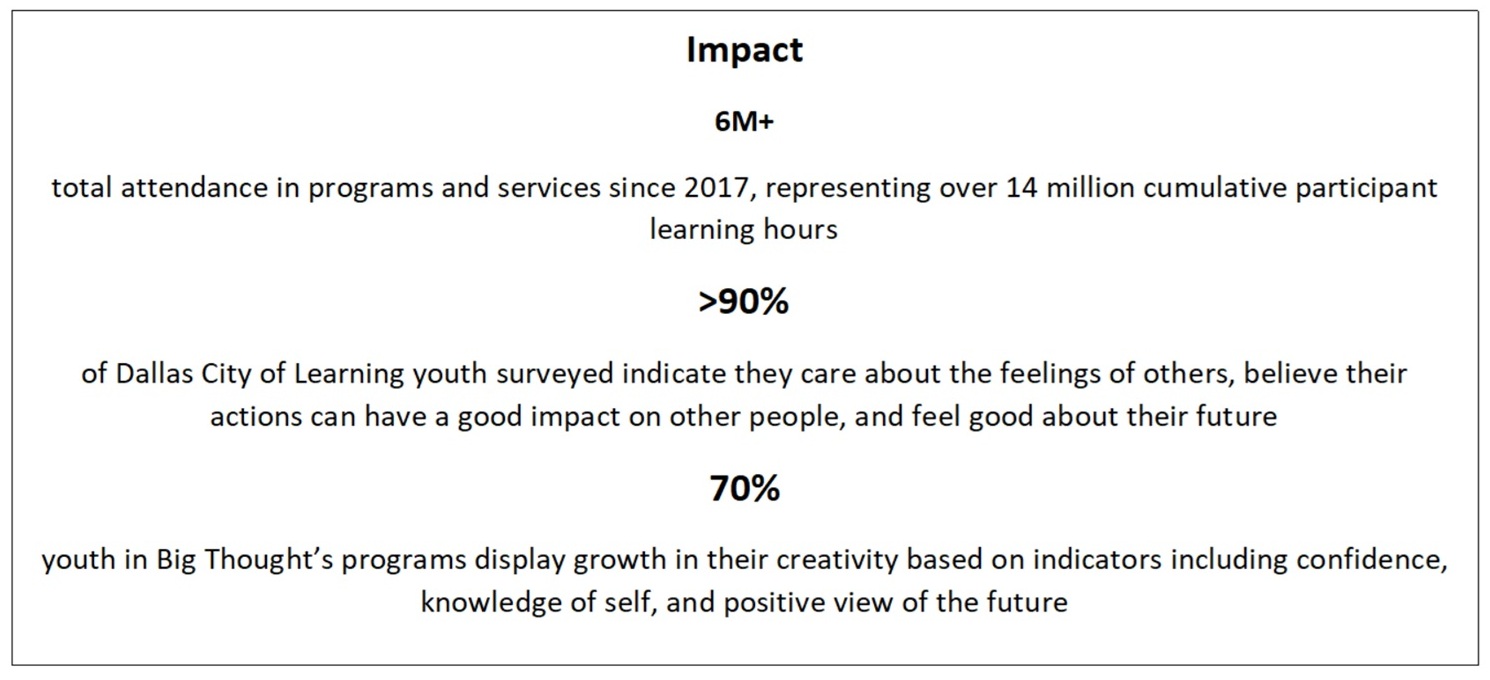
The distributed model built by Big Thought ensures access, flexibility, and equity by not only increasing learning opportunities but also tracking engagement through a citywide platform. As noted in the BTI Brief:
“Similar communities can adopt this framework by mapping partners, aligning to academic and creative competencies, building a lightweight badging and data backbone, and funding distributed dosage rather than single-site duration. Policy can legitimize badges and out-of-school learning credentials as recognized demonstrations of skill.”
The brief concludes with implications for practice and policy:
- “Invest in flexible, decentralized models.
- Fund data infrastructure.
- Resource community ecosystems.
- Focus on engagement and dosage.
- Support holistic data collection.”
Cogent advice. We’ll continue to share profiles of ecosystem intermediaries over the next few months.
***
Merita Irby, co-founder of the Forum for Youth Investment, is a partner at Knowledge to Power Catalysts.
In her columns, Karen Pittman is exploring the research behind the statement, “When Youth Thrive, We All Thrive.”