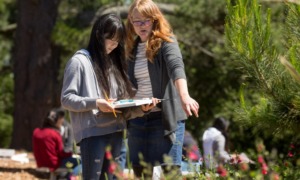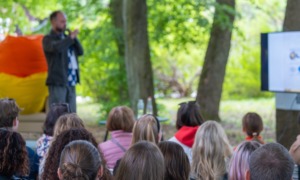


The powerful piece by Erika Easy, Angelina Rosario and Jeanlis Rodriguez reminds us of what is possible when young people are offered opportunities for robust engagement with science, technology, engineering and math (STEM) in a variety of settings. The opportunities being offered at United Charter High Schools for Advanced Math and Science (AMS) are impressive and clearly having an impact — it has enabled these three young people to not only learn and plan their own STEM careers but also bring STEM to other, younger students at their school. They are role models and changemakers.
The interest they found among younger students is not a surprise; children often start out very interested in science and technology but lose interest when adults do not nurture that interest. Too many students — and especially those in underserved communities and girls — are missing out on opportunities to engage and deepen their interest and skills in critical STEM fields like computer science, engineering and physics.
[Related: Expanding horizons, essential relationships — The evidence of afterschool impacts]
STEM occupations are projected to grow by more than 10% by 2032 and 20% of all jobs will require a high level of knowledge in a STEM field. As the urgency increases to have a more STEM-skilled population, our cultural conversations must change to acknowledge this need and welcome everyone to contribute their talents to the STEM workforce.

Courtesy of Anita Krishnamurthi
Anita Krishnamurthi
The recently released “Talent Strategy” from the Trump administration acknowledges the need for a STEM-ready, AI-literate workforce. We need more STEM education and opportunities for our youth and we know that schools can’t do it alone! Young people spend 80% of their waking hours outside of school, so out-of-school-time (OST) and afterschool programs are an important part of the STEM education landscape. And the evidence for the outcomes they produce keeps growing — we can now say with full confidence that high-quality afterschool STEM programs excite and engage youth in these fields. Afterschool programs have already been engaging youth in STEM-focused career readiness programs and can and will step up to support the new Talent Strategy. For example:
- The Boys & Girls Club of Western Pennsylvania has been hosting a three-week Artificial Intelligence Pathways Institute Activation Camp for the past six years, during which students engage with AI through hands-on activities and compete in AI challenges. The students even earn a stipend for their participation.
- The Scientific Adventures for Girls program partners with local schools to offer afterschool STEM experiences which range from technology and aviation science to agricultural and environmental science and also connect the students to STEM role models and near-peer mentors. After participating in the program, 83% of the girls say they want to do more science and 72% say they want to do more engineering, specifically because of their experiences in the afterschool program.
As afterschool programs pay more attention to youth voice and empowering youth to be co-creators in their learning journey, we should all remember that young people choose to pursue subjects and issues that feel relevant and meaningful to them. We believe one of the keys to success in engaging more young people in STEM is to pair it with civic engagement in their communities so they can use STEM knowledge, skills and tools to tackle issues they care about. With so many of the solutions to the biggest problems our society faces (environmental degradation, emerging and evolving diseases, and food and water shortages, to name just a few) rooted in science, we believe STEM education will be most successful when it’s paired with opportunities for leadership and social action. We need to build capacity for young people to engage and lead, and “arm them” with STEM knowledge as they tackle the most pressing issues we face.
Instead of investing in innovations like this, it’s troubling that the federal government seems to be abandoning its commitment to STEM education. The proposed consolidation of the 21st Century Community Learning Centers grants — the only dedicated federal funding stream for afterschool — into a larger pot would mean less money for afterschool STEM programs. This combined with the proposed elimination or consolidation of STEM education funding at science agencies like NASA and the National Science Foundation (NSF) would lead to fewer opportunities to engage and skill up young people at this time when we need to be increasing our investments.
All of us who want to improve our society in the here and now while also taking steps to build a bright future should be speaking out and pressing for more, not less, government investment in STEM education. And educators and those of us in youth development should be looking to prepare the next generation to be engaged changemakers in our STEM-driven world. Together we can cultivate a new generation of active and empowered citizens who can transform communities throughout the United States and worldwide. These resources can help you do that:
- Become knowledgeable about afterschool STEM education policy — register for the STEM Talk webinar series and watch previous episodes.
- Find resources to advocate for afterschool STEM.
- Contact Congress and take action to protect STEM education funding!
- See how to make connections between STEM and communities.
***
Anita Krishnamurthi is the Senior Vice President for STEM & Youth Civic Engagement at the Afterschool Alliance, where she oversees the Alliance’s national STEM initiatives including the Afterschool STEM Hub and the Collective for Youth Empowerment in STEM & Society (CYESS). Anita has a PhD in Astrophysics and moved to a career focused on informal STEM learning as she is deeply committed to promoting enjoyment, access, and engagement with science and supporting all young people on this journey.