

Since the earliest national efforts to support young children, leaders like Edward Zigler argued for continuity between early childhood programs and the early elementary years. His research underscored the inseparability of early care and education (ECE), inspiring models that layered school‑day learning with afterschool and wraparound supports for children from marginalized communities.
That legacy raises a radical question: What if continuity did not end at the program or grade level?
What if aligned supports extended across child care, afterschool and K-12 systems so every child could access equitable beginnings and a sustained continuum of care and learning through the early elementary years? And what if those supports were designed not as isolated interventions, but as cumulative opportunities — layered across time and settings — so that each additional chance to thrive built upon the last?
[Related: From systems leadership to ecosystems stewardship — A next step for OST intermediaries?]
Policies that foster collaboration and alignment across systems could do more than reduce fragmentation; they could cultivate a continuity of care and cumulative opportunity structure that augments student development and long‑term outcomes. In this vision, equity is not a single program characteristic or investment, but the compounding effect of opportunities that follow children across developmental stages, ensuring durable impacts on learning, belonging and future success.

Snapshot of children 0-8
- As of 2020, 35.3 million children in the United States were of the ages 0-8, which is roughly 47.8% of the total population of children.
- Many young children are subject to differential experiences that yield opportunity gaps as a result of access and quality in ECE.
- Young children of color experience significant opportunity gaps as a result of fragmentation in ECE and the disconnect between ECE and early elementary.
- School-age children comprise almost half (45%) of those served with Child Care and Development Fund (CCDF) funds.
 Out-of-school time (OST) occupies a unique space between education and child care, offering flexibility to meet young people where they are while navigating disconnected systems. Yet when funding and governance are parceled into silos, children experience uneven access and fragmented supports.
Research on cumulative opportunities shows that what matters most for long‑term outcomes is not a single program occurrence, but the accumulation of opportunities across contexts and developmental periods. Children from low‑income households often encounter fewer growth‑promoting opportunities at home, in early childhood programs, schools, afterschool settings and neighborhoods. These disparities compound over time, shaping differences in educational attainment and earnings in adulthood. Each additional opportunity matters most for those who have had the fewest chances to thrive.
Why preK-grade 3?
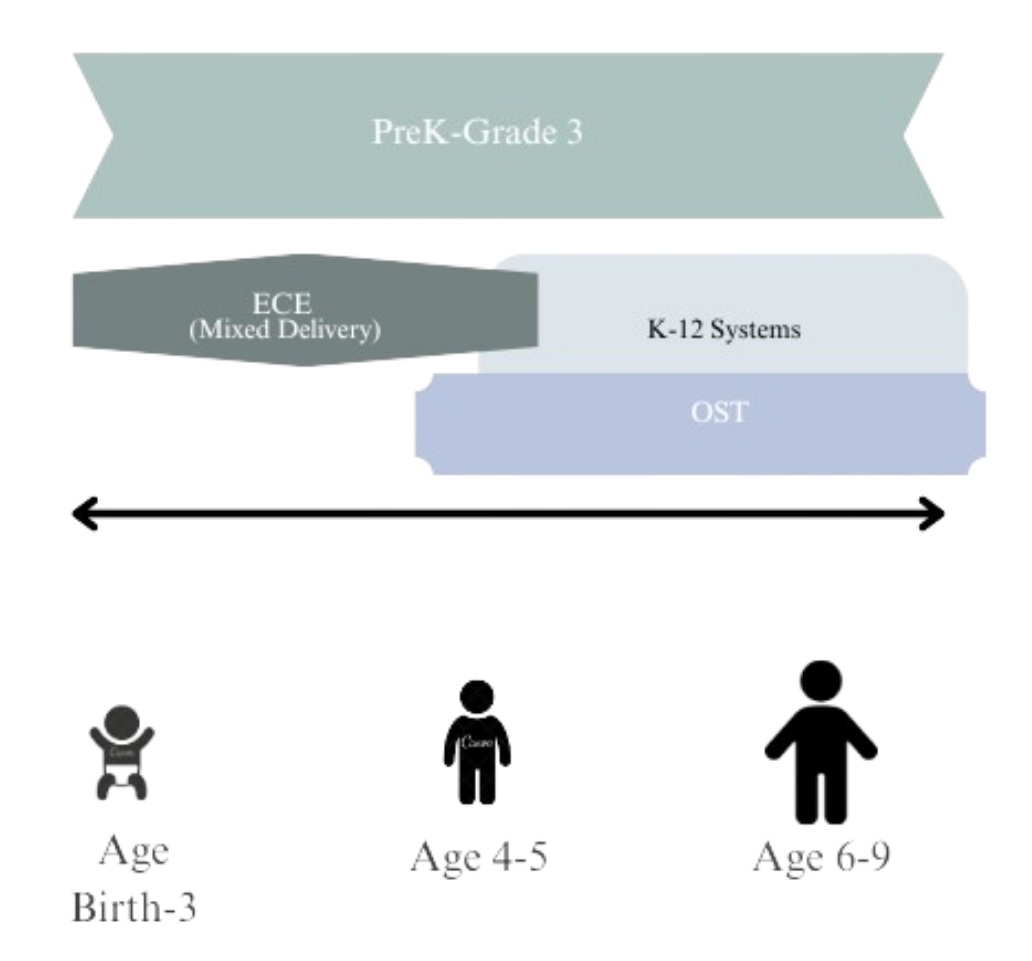 The preK-grade 3 span provides a practical blueprint for reducing fragmentation, but only when ECE, child care, afterschool and K‑12 systems are treated as essential partners in cultivating cumulative opportunities. When OST is intentionally integrated into this continuum, children receive continuous mentorship, enrichment and academic reinforcement that amplify classroom gains and sustain engagement. Afterschool Alliance has captured OST as an engine for connection that reduces chronic absenteeism and keeps students linked to caring adults outside the school day.
California offers a compelling example. In addition to universal preK, the state has embraced a universal approach to OST, extending quality programming well beyond the bell for thousands of children, including early learners. This intentional layering of supports reflects a growing recognition that cumulative opportunities — stacked and linked across child care, OST and K-12 systems — yield the most durable effects on long‑term achievement. Targeting this span concentrates resources where small, well‑aligned investments compound into large, lasting impacts.
What works
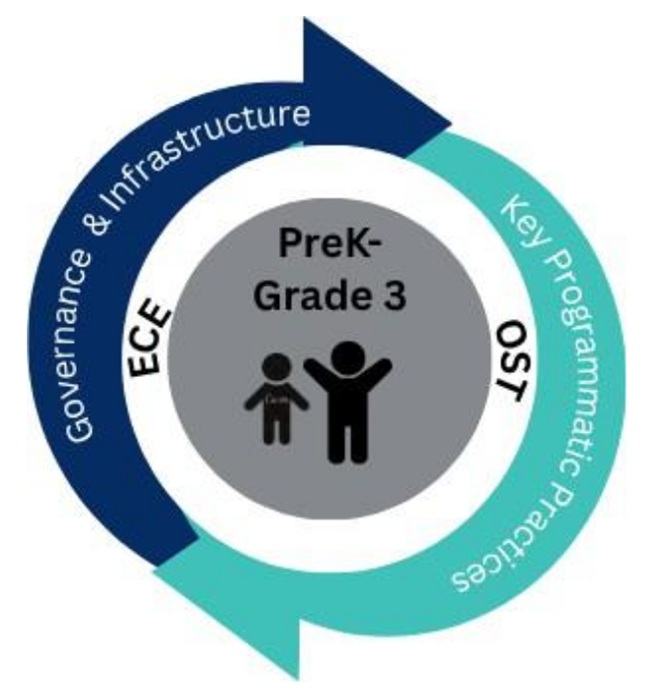
My recent dissertation work revealed a blueprint for states and local leaders to cultivate optimal opportunities. When states align policy and funding across systems, they create the conditions for OST programs to thrive. Missouri provides one example, where coordinated grants and joint oversight intentionally connect 21st CCLC, school‑age community grants and early childhood services. Integrated data systems and shared professional learning further strengthen alignment, enabling programs to track child and family outcomes, reduce duplication and target resources where they are most needed. In this model, governance establishes the infrastructure, alignment operationalizes it across systems and a preK-grade 3 focus ensures continuity of opportunities.
Design principles

Courtesy of Ashley Watts
Ashley Watts
State level: States occupy a uniquely powerful position to drive reform and catalyze innovation across early learning systems. When state leaders convene partners and launch cross‑sector initiatives, they model what collaboration, inclusion and alignment can look like in practice. Programs such as Michigan’s Lifelong Educational Advancement and Potential Initiative demonstrate how state action can center equity, coordinate funding and policy and scale promising practices across settings.
Local level: Local education leaders serve as the essential bridge between policy and practice. By organizing linked‑teaming across regions, districts and programs, local leaders ensure that governance and mandates translate into practical support, coaching and continuous improvement at the classroom level. Regional education agencies exemplify this critical link, showing how state priorities can be transformed into actionable strategies that directly benefit children and families.
Program level: It’s important for programs to remain flexible to meet the unique needs of their communities, while aligning with state and local visions to ensure cohesion from design through implementation. Key elements include remaining culturally affirming, using program‑level data to guide decisions and embedding family and community engagement throughout. Instruction and activities should highlight student strengths, while professional development must be unified so that educators across the school day and afterschool share a common language, aligned learning outcomes and pedagogies that center both play and culture.
Across all domains, the evidence points to strong cross-sector foundation depending on simple, shared data systems to track participation and outcomes, aligned partners working horizontally and vertically, and a small set of shared design principles that guide decisions. Regular joint meetings and unified professional development create space for classroom educators, OST providers and leaders to co-plan and strengthen developmentally appropriate practice. Collaborative leadership sets the vision, while families, engaged and compensated as true partners, ensure programs reflect community priorities and lived experience.
Future forward
Ultimately, children deserve continuous access to high‑quality instruction, enrichment and support as they grow. Governance creates the infrastructure; alignment operationalizes it across systems and a preK-grade 3 focus preserves opportunity through grade 3 and beyond. With shared metrics, formal roles and braided funding, OST can move from a patchwork of programs to a cohesive ecosystem that advances equity and learning.
OST should be treated as a vital part of the continuum, not an afterthought.
The path forward requires comparable evidence to attract braided funding and policy commitments that institutionalize successful models. It demands governance representation, family co‑design and actionable data to secure sustained investment for young learners. By advancing continuity of care and cumulative opportunities, we can move beyond fragmentation toward a future where every child experiences equitable beginnings and durable pathways to success.
***
Ashley Watts, Ed.D. is a Texas‑based former 21st CCLC and community-based program leader who researches out‑of‑school time through an interdisciplinary lens. Her work connects early childhood education and policy and centers practice informing the design of equitable programs and systems alignment.