

 Founded more than a decade ago, America Succeeds is a national nonprofit focused at the intersection of education and employment, with the hope of building better bridges between those two sectors and, even more granularly, supporting economic mobility through cutting-edge research, strategic advocacy, cross-industry partnerships and practical solutions like the Pathsmith Durable Skills Framework.
I had the opportunity to talk with Michael Crawford, Ph.D., vice president of strategic initiatives, about America Succeeds’ history and bold goals for the future, including why they have joined the Alliance for Youth Thriving.
This interview has been edited for length and clarity.

Q: Talk about the problem America Succeeds was set up to try to solve.
One of the main things that has been challenging for young people as they get older is their ability to acquire the necessary relationships, experiences, skills and competencies to get a good job that allows them to live their version of the American dream. About ten years ago, our co-founders began hearing over and over from the business community that young people coming out of postsecondary spaces weren’t necessarily connected to the world of work. Tim Taylor, one of our co-founders and current president, thought, “If we can better connect the employment system, the workforce, the professional spaces with the education space, then young people will be equipped, employers will get the kind of talent they need, communities will thrive, families will flourish.”
[Related: Navigating to next — Making complex pathways clearer with people-powered supports]
Growing out of the success of Colorado Succeeds, America Succeeds was founded as the business voice in education with a policy advocacy emphasis. It would listen and understand what businesses and employers were looking for and then work backwards into the education space, aiming to influence legislation and enable key systems to more effectively help young people get what they need to thrive as they move forward.
Q: How did you come to focus on skills?
America Succeeds initially focused on supporting a network of state-based affiliates, then expanded its national presence in 2018 with the launch of The Age of Agility, shifting the conversation on workforce readiness to acknowledge the flexibility and skills required for the ever-changing needs of the modern workforce.
In 2021, we identified the growing demand for these skills and popularized the term “durable skills” with the release of our High Demand for Durable Skills report. This policy and advocacy work laid the foundation for America Succeeds to become the premier thought leader on durable skills by providing employer-informed, research-backed insights and solutions, like Pathsmith. Today, we work with education and workforce leaders to ensure all learners and earners can build, demonstrate and validate the durable skills essential for economic mobility and lifelong success.
Q: Youth Today’s readers span the learning and development ecosystem. So, I have to ask, when you say education are you talking K-12 schools? higher ed? OST and workforce development systems?
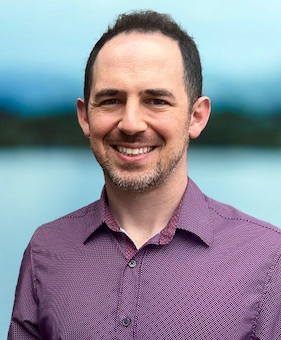
Courtesy of Michael Crawford
Michael Crawford
All of the above. We are sector agnostic. We work with school districts, out-of-school time networks, technology providers, community colleges, universities, teacher training programs, employers and the large governing and HR management associations. We really see ourselves as being a key ingredient supporting the interconnectedness of these different sectors.
Q: As the business voice in education, how did you develop the Durable Skills Wheel and how did you make sure it represents all sizes and types of businesses?
Employers all over the country, at different levels, different industries, told us they could find folks with technical skills, but they had a much harder time finding people with other traits or competencies like problem-solving, communication and collaboration. This challenge inspired us to dive into the research literature. We looked at the different skills taxonomies many people are familiar with — 21st century skills, soft skills, essential skills, SEL skills. We cross-walked them to find commonalities and came up with an overlapping set of ten. We initially called them “skills that last.” A business leader in one of our convenings said, “It sounds like you’re talking about durable skills.” The term stuck.
Q: The list of 10 durable skills resonates across sectors. Did the more detailed sub-skills lists also come from your research review?
No. They came from employers. We partnered with Emsi Burning Glass, now Lightcast, a large employment database company that shared a list of 400 search terms included in job descriptions from across the spectrum — for profit, nonprofit, big, small, government. We culled the 400 down to 100 terms, then ran those sub-skills, plus our ten durable skills, through 80 million job descriptions to see if these are the key skills, the top skills that employers are looking for. They were. Seven of the top ten most requested skills were durable skills — and the top five most requested durable skills were requested almost five times as often as the top five technical skills. Our updated analysis from July 2025 reinforces similar findings.
Q: Did the data surprise you?
It was revelatory. It confirmed that we were onto something with this list of skills. So we took that list and arranged it in a wheel we called the Durable Skills Wheel with the 10 durable skills competencies on the inside and the 100 sub-skills on the inside and released that out into the world in 2021. That release was greeted with great enthusiasm from both the education and employment sectors, which encouraged us to keep moving forward.
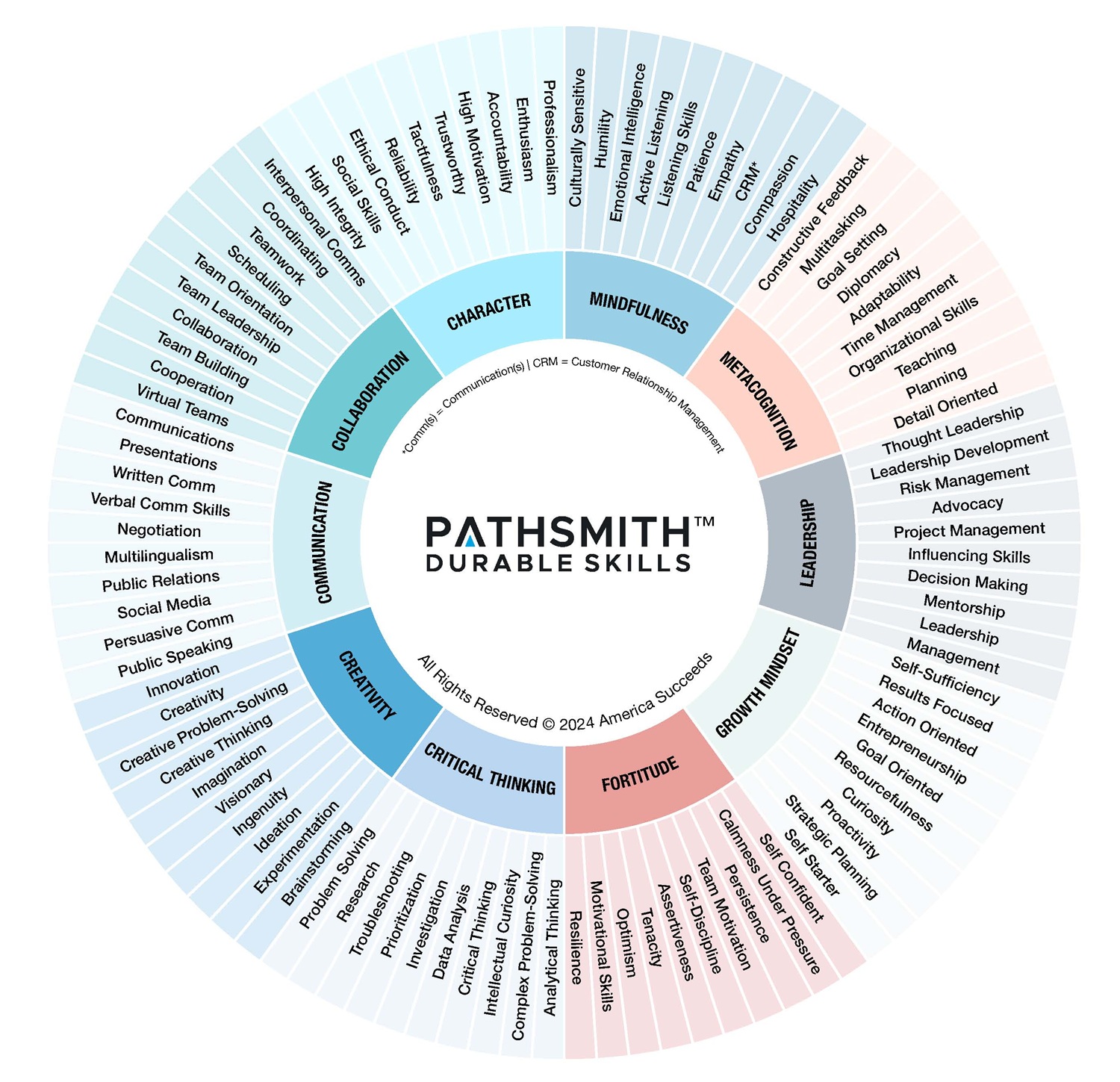
Q: What prompted the progression from the Durable Skills Wheel to the Durable Skills Framework?
We thought, okay, it’s great that people can see what skills employers are looking for both in education and in the workforce. But if we wanted to really make an impact, we would need to help folks be able to train or develop these skills, and then ultimately be able to measure these skills and know whether they or their employees had them. We needed to build a tool — a way of helping on the development and learning side, and some way on the measurement and assessment side. So we worked with 20 subject matter experts — folks from academia, from workforce development, employers — to create a rubric, what we dubbed our Durable Skills Framework and currently refer to as the Pathsmith Durable Skills Framework. This framework includes all of the sub-skills that describe what early career professionals should know and be able to do across four performance levels from the first level Emerging, which is just beginning to use this skill, to the fourth level, Exceeding, which is being able to use this skill at a high level unconsciously across multiple contexts.
Q: Both the level of a skill needed, like communication, and the nuance of how to use it vary across sectors and industries. How was this challenge addressed in the rubric language?
In partnership with CompTIA, we convened and got feedback from more than 800 employers nationwide, including large companies — like McDonald’s and Intel — to community college presidents to small business owners to nonprofit leaders. All weighed in on the extent to which the language in the framework applied in their work. We then released that framework out into the world in January of 2024 in two versions. A free version, our Starter Edition, that anyone can go to our website and download. It has all of the sub-skills described but only at the Applying level, the third level of four. The full framework, which has all the sub-skills at all four performance levels, is licensed to different partners — employers, ed tech providers or universities that want to build courses or integrate it or embed it into the products, services, platforms and solutions they’re offering.
Q: The Durable Skills Framework is quietly contributing to training and measurement consistency across developers as planned. So what’s the reasoning behind Pathsmith, the new America Succeeds brand?
When we released the Starter Edition, we completely underestimated how many people were going to take a look at it. We were thinking low hundreds, maybe, over the course of a couple years. At this point, we are up over 2,000 downloads of the Starter Edition, and those downloads are coming from all over the economy and all over the education system more broadly. About half of the downloads are from folks in K-12 — superintendents, instructional coaches, educators or school leaders. The other half are coming from postsecondary and workforce-industry associations, employers themselves, nonprofit leaders.
Had the response been more modest, we wouldn’t have felt the need to create a brand. But as more companies, organizations and initiatives started using the durable skills terminology, we needed a way to help customers or students purchasing or using a product that claims it is teaching or measuring durable skills know they are getting a product built with our gold standard framework. The term durable skills wasn’t trademarkable. So we launched the Pathsmith Durable Skills Framework brand in August 2025. Same employer-driven, research-backed rubric, new name.
Moving forward, America Succeeds has two arms: research and advocacy and the new arm, Pathsmith, which is much more solution-oriented and practical in nature. The two arms complement each other.
Q: Let’s turn to the new pilot project you’re launching to respond to interest in the K-12 space. We loved the clear messaging to everyone who works with youth in your announcement:
We’re inviting educators from across the country to pilot test draft resources from the forthcoming K–12 Durable Skills Framework. Whether you’re a classroom teacher, instructional coach, counselor or youth program staff member, this is your chance to shape tools that will help learners build durable skills — the real-world skills they need to thrive in life, learning and work. This is a low-lift opportunity with high impact — and your voice will help shape what comes next.
But we have to ask, why introduce another skills framework into the crowded K-12 space?
We think that our contribution to this space is meaningful for a few different reasons. One, none or almost none of the current frameworks are coming from an employer perspective. Two, the evolving nature of the future of work is accelerating faster than the ways in which learning environments and education systems are evolving. The gap between the two is growing, and there is more awareness of that now.
Our project aims to provide resources, tools and language for adults that are working with young people to learn from and listen to employers and bring that into their classrooms and learning experiences. The pilot phase of the K-12 project opens on October 27th and closes on December 19th. Educators do not have to sign up by October 27th in order to participate. That is just the day that the first resources get deployed. The pilot is free to join, which can be done right now at americasucceeds.org/k12.
When the pilot opens, you will get an email with a link to the bundle of resources, and you’re off and running. Pick one or two, use them and then give us feedback. That’s the minimum commitment. Simple as that. By participating, you’ll get entered into a raffle to win $100 gift cards, get first access to the final materials, and receive an invitation to our new educator community of practice.
[Related: Q&A: The Alliance for Youth Thriving]
Our hope is to make it easy for educators and other adults working with young people who may already be helping young people develop skills but not necessarily labeling them as durable skills be able to pick and choose some resources they can apply in their contexts. It’s one thing to help young people develop skills. It’s another to help them develop skills, know which skills they’re developing, and be able to articulate those skills and their supporting evidence in ways that are relevant for them, be it in a college essay, job interview or anywhere else.
Q: Why is it important to cast a wide net for the pilot?
School environments are important. But school comes with some constraints. What happens outside of school is more often driven by young people. This is a critical developmental element of an experience and of a program. We know that these kinds of skills are best developed when the work that’s being done is authentic and real and meaningful. Oftentimes, in school, you give a great poster presentation, and then you throw your poster in the garbage on the way out. In out-of-school time spaces, young people have opportunities to do things that matter beyond just getting a grade. They get to host fundraisers, they get to rebuild houses, they get to put on performances.
The resources aren’t designed to be used in any one specific context. A teacher, a Boy Scout troop leader and a youth theater leader could pick up the same resource and be able to apply it in their context. We did that on purpose because we know there are a range of adults that support young people, and there are likely to be a lot more adults who want to help young people develop these skills if they had tools. We need to know which tools work for them.
Q: How do you plan to engage in the Alliance for Youth Thriving?
We don’t want to just build a bunch of solutions and go looking for problems. We want to be able to hear how and where people want resources and what they don’t in order to help co-create and build those. What excites me about the Alliance is being able to bring our employer, career and business perspective to a group of educators, afterschool providers, volunteer associations, technology organizations and more that are helping to shape young people’s development.
Oftentimes, you’re learning because you’re interested, it’s important for graduation, or you’re preparing for the workforce. The distinction between learning and earning is becoming less clear, and I think what the Alliance aims to accomplish, at least from my perspective, is to help the walls between the silos dissolve.
***
In her columns, Karen Pittman is exploring the research behind the statement, “When Youth Thrive, We All Thrive.”