
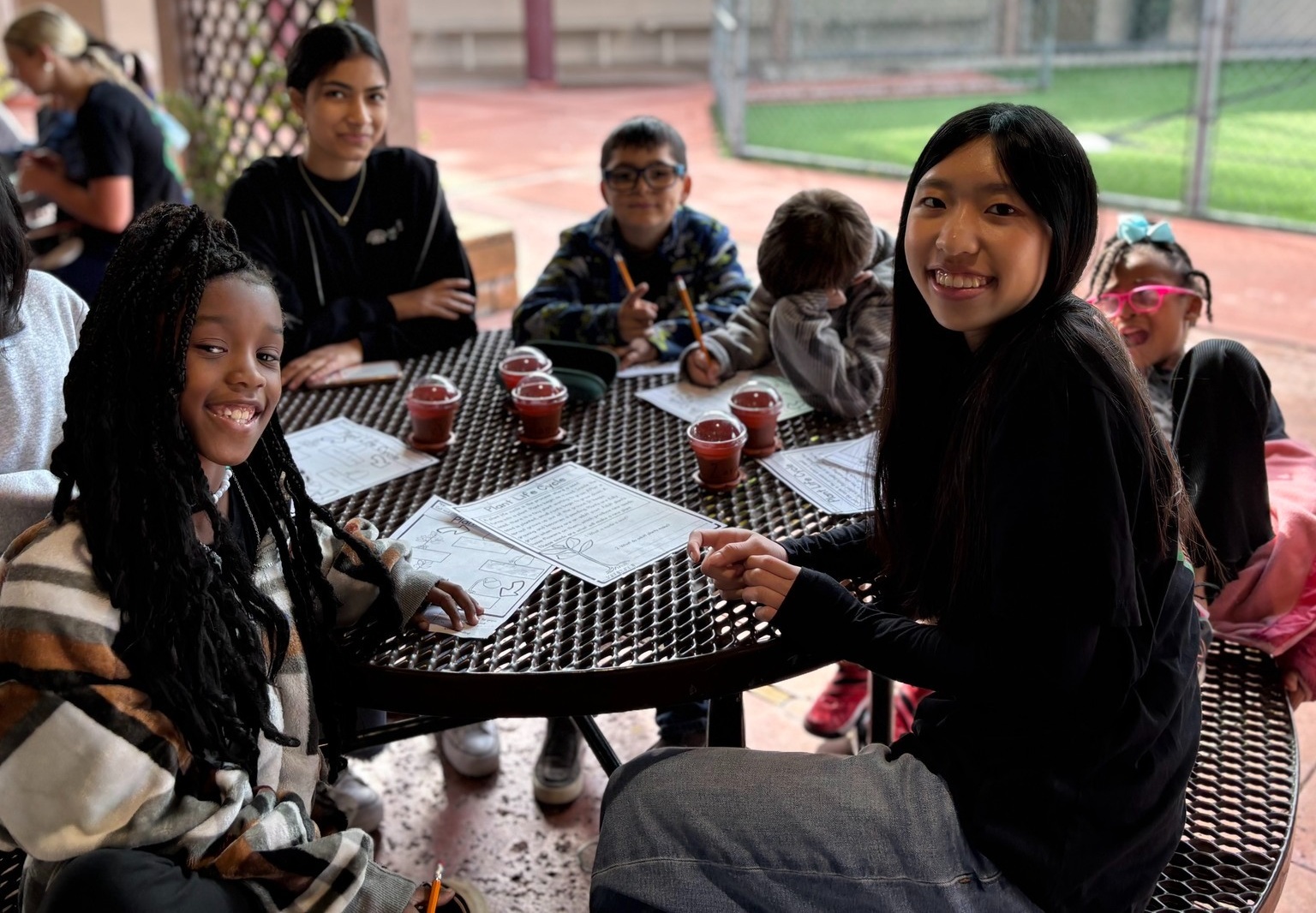
When considering why I have stayed for three decades in the field of youth development programming for school-age children in lower-income families, including almost a decade at the nonprofit Horizons National, I think about the lasting impacts these programs can have.
In speaking about his early OST experiences, Dr. Da’Von Boyd, alumnus of the Horizons program, and now founding member of the Horizons National Associate Board and Horizons National Board member said, “What I appreciate about Horizons is that it expanded my horizons — no pun intended — to have a more holistic interpretation of what it means to grow into my own self.”
Horizons National
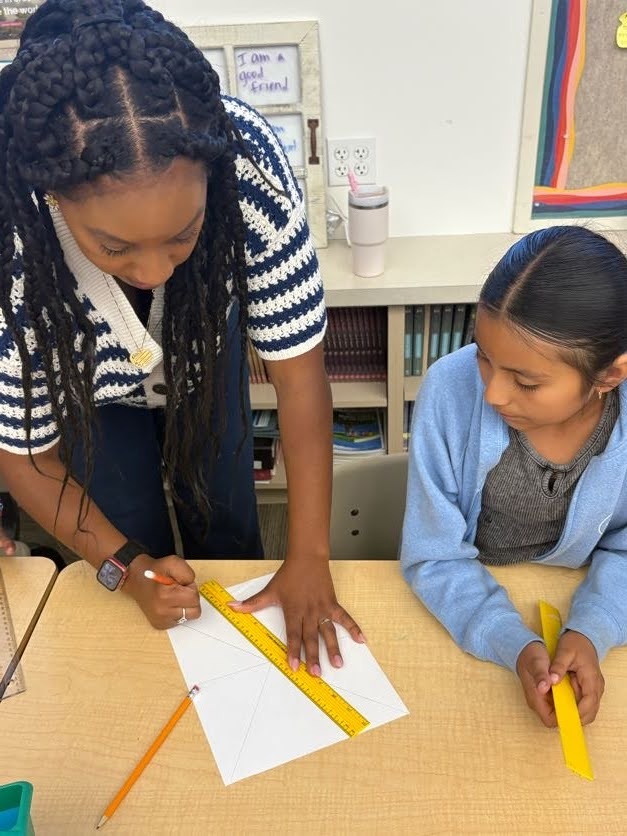
An educator helps a student draw precise lines and angles using a ruler.
It is no surprise that Horizons has a significant impact on students. Our last rigorous third-party evaluation study, funded by The New York Life Foundation and the Scripps Family Fund for Education and the Arts, defined “long-term” as participation in Horizons for at least four summers (in grades K-8) and found that compared to peers, long-term Horizons students experienced long-term gains from their participation in the program. These included:
Better Attendance and Less Chronic Absenteeism
- Elementary and middle school participants had attendance rates approximately 1.1 percentage points higher, equating to about two extra days of school annually
- Chronic absenteeism dropped from 9.3% in comparison students to 3.8% for Horizons participants
Stronger Standardized Test Performance in Elementary School
- Horizons students outperformed peers by 10.5 percentage points in math proficiency
- In science, they held a 10.4 percentage point advantage
Higher GPA in Transition to High School (9th grade)
- Average GPA for Horizons students was 2.9 (approximately a B) vs. 2.3 (approximately a C+) for comparison peers
More Course Credits Earned
- By the end of 9th grade, Horizons students earned 7.8 credits vs. 6.8 credits for peers (equivalent to one full-year course)
- By the end of 10th grade, the gap grew to 1.7 credits, equivalent to nearly two full-year courses
Fewer Grade Retentions & Disciplinary Referrals in HS Transition
- In grades 9 and 10, fewer than 4.7% of Horizons students repeated a grade versus 12.5% of comparison students
- Disciplinary referrals also occurred at significantly lower rates for Horizons students during this period
These promising results are consistent with effects found with other high-quality, intensive, multi-year interventions and begin to fill an important gap in the research looking at the long-term impacts of out-of-school-time (OST) programs.

Horizons National
A group of students each sit in their own hula hoop while taking part in an educational exercise.
This evidence is reinforced by new groundbreaking research: Organized Afterschool Activities as a Developmental Context for Children and Adolescents, a longitudinal study led by Dr. Deborah Vandell of the University of California, Irvine. This 26-year study followed a large sample of young people to understand how various environments — including families, early education, schools, neighborhoods and afterschool programs — affect educational, health and career outcomes. For the first time, the data show results into young adulthood and confirm that the benefits of afterschool programs endure for life.
The findings are clear: kids who participate in afterschool
are stronger learners, earners, and leaders.
Among the enduring results from the Vandell study, structured by stage of development, are:
Elementary School (Ages 6-10)
- Consistent participation leads to higher math and reading achievement (beyond family/school effects).
- Stronger social skills and positive peer/adult relationships.
- Fewer behavior problems.
Secondary School (Ages 11-18)
- Elementary participation predicts higher academic achievement at age 15.
- Participation in middle/high school → higher GPAs, test scores, and engagement in challenging coursework.
- Greater social confidence and civic engagement.
- Reduced risky behaviors and substance use (alcohol, marijuana).
Young Adulthood (By Age 26)
- Early participation predicts higher educational attainment, income, and occupational status.
- More likely to earn college degrees and maintain a healthy lifestyle.
- Reduced arrests and substance use.
Why do afterschool and summer learning programs have the potential to have these sorts of life impacts? Children and youth need to experience rigorous and relevant learning environments, as well as have their basic needs (housing, food, healthcare) met. This we know. However, to thrive, they also need to be surrounded by caring relationships in all the spaces (and systems) they inhabit. The Search Institute’s State of Developmental Relationships, 2025 Annual Report underscores this truth: “It’s difficult, if not impossible, to find any positive developmental outcome that isn’t shaped by relationships. Each and every young person needs developmental relationships — the close connections through which young people discover who they are, cultivate abilities to shape their own lives, and learn how to engage with and contribute to the world around them.”
As social beings, we learn and grow in the context of relationships — and when these are paired with high quality learning and leadership opportunities, real transformation happens. This is a hallmark of high-quality OST programs everywhere.
[Related: The healing power of camp — Trauma-informed adventures for kids in foster care]

Courtesy of Dara Rose
Dara Rose
At Horizons, we commit to building these relationships and sustaining them with children and their families as they transition into different school environments and developmental stages, offering an anchor of constancy from the summer before students enter Kindergarten through the summer before starting high school. Many Horizons programs also maintain contact and offer varied programming, ranging from internship placement to college tours for Horizons students grades 9-12.
A Horizons alumnus and now member of the Horizons National Board, Josh Dumas said, “Horizons isn’t just K-8…it’s Kindergarten to life!” and students currently in the program echo this sentiment.
The long-term nature of our program has students and staff alike often refer to the program as a family.
When asked why he continues to come, a rising 9th grade student completing his ninth summer in the Horizons at Lancaster Country Day School program said, “It’s not my real family but it’s a family. We’ve known each other since we were little. When we argue, they don’t last long. They’re my Ride or Die.”
He also mentioned that his little brother and cousin are in the program in the lower grades. This isn’t coincidental. Horizons prioritizes familial enrollment in our policies, and his program loops teachers so the same cohort of students not only are together every summer, but their lead teacher also follows them from 6th through 8th grade.
Taken together, this research all points to the same conclusion: learning and development are most powerful when they are grounded in relationships.
***
As a senior vice president at Horizons National, Dara Rose leads service provision inclusive of peer learning, policy setting and implementation support to a network of affiliates in 20 states. Previously, she worked over a decade at The Wallace Foundation and, prior to that, spent over 15 years as a youth worker, program coordinator and manager at several New York City-based nonprofits.