


This story was originally published by The Hetchinger Report.

Trump administration lawyers admit some DOGE cuts violated congressional statutes
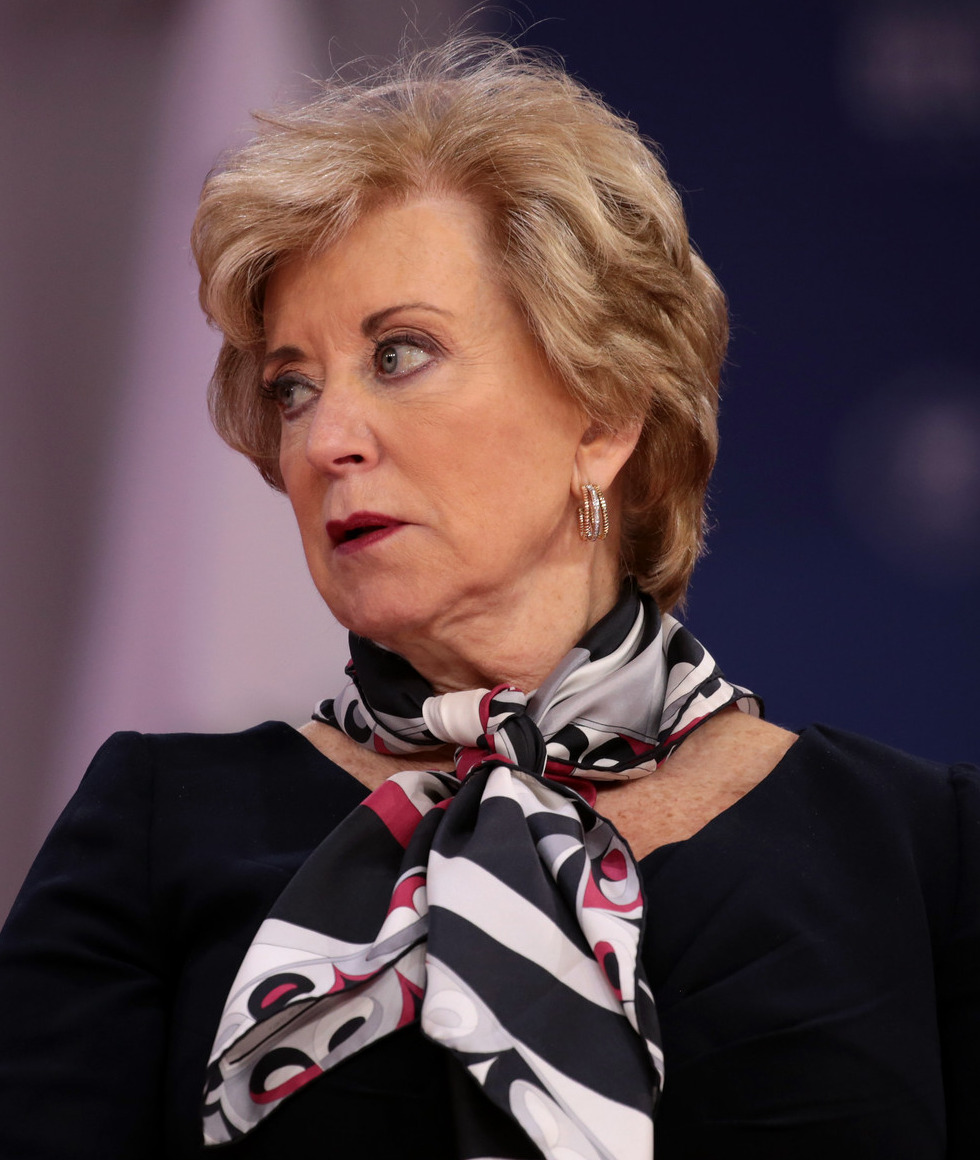
Gage Skidmore/Flickr
Linda McMahon, U.S. Education Secretary.
Education Secretary Linda McMahon has repeatedly said that the February and March cancellations and firings at her department cut not only the “fat” but also into some of the “muscle” of the federal role in education. So, even as she promises to dismantle her department, she is also bringing back some people and restarting some activities. Court filings and her own congressional testimony illuminate what this means for the agency as a whole, and for education research in particular.
McMahon told a U.S. House committee last month she rehired 74 employees out of the roughly 2,000 who were laid off or agreed to separation packages. A court filing earlier this month says the agency will revive about a fifth of research and statistics contracts killed earlier this year, at least for now, though that doesn’t mean the work will look exactly as it did before.
The Trump administration disclosed in a June 5 federal court filing in Maryland that it either has or is planning to reinstate 20 of 101 terminated contracts to comply with congressional statutes.
More than half of the reversals will restart 10 regional education laboratories that the Trump administration had said were engaged in “wasteful and ideologically driven spending,” but had been very popular with state education leaders. The reinstatements also include an international assessment, a study of how to help struggling readers, and Datalab, a web-based data analysis tool for the public.
Even some of the promised reinstatements are uncertain because the Education Department plans to put some of them up for new bids (see table below). That process could take months and potentially result in smaller contracts with fewer studies or hours of technical assistance.
These research activities were terminated by Elon Musk’s Department of Government Efficiency (DOGE) before McMahon was confirmed by the Senate. The Education Department’s disclosure of the reinstatements occurred a week after President Donald Trump bid farewell to Musk in the Oval Office and on the same day that the Trump-Musk feud exploded on social media.
IES contracts have been or are slated to be restarted, or under consideration for reinstatement
Click arrow for table of contracts and their status
| 1 | Regional Education Laboratory – Mid Atlantic | Intends to seek new bids and restart contract |
| 2 | Regional Education Laboratory – Southwest | Intends to seek new bids and restart contract |
| 3 | Regional Education Laboratory – Northwest | Intends to seek new bids and restart contract |
| 4 | Regional Education Laboratory – West | Intends to seek new bids and restart contract |
| 5 | Regional Education Laboratory – Appalachia | Intends to seek new bids and restart contract |
| 6 | Regional Education Laboratory – Pacific | Intends to seek new bids and restart contract |
| 7 | Regional Education Laboratory – Central | Intends to seek new bids and restart contract |
| 8 | Regional Education Laboratory – Midwest | Intends to seek new bids and restart contract |
| 9 | Regional Education Laboratory – Southeast | Intends to seek new bids and restart contract |
| 10 | Regional Education Laboratory – Northeast and Islands | Intends to seek new bids and restart contract |
| 11 | Regional Education Laboratory – umbrella support contract | Intends to seek new bids and restart contract |
| 12 | What Works Clearinghouse (website, training reviewers, but no reviewing of education research) | Approved for reinstatement |
| 13 | Statistical standards and data confidentiality technical assistance for the National Center for Education Statistics | Reinstated |
| 14. | Statistical and confidentiality review of electronic data files and technical reports | Approved for reinstatement |
| 15 | Datalab, a web-based data analysis tool for the public | Approved for reinstatement |
| 16 | U.S. participation in the Program for International Student Assessment (PISA), an international test overseen by the Organization for Economic Cooperation and Development (OECD) | Reinstated |
| 17 | Data quality and statistical methodology assistance | Reinstated |
| 18 | EDFacts, a collection of administrative data from school districts around the country | Reinstated |
| 19 | Demographic and geospatial estimates (e.g. school poverty and school locations) used for academic research and federal program administration | Approved for reinstatement |
| 20 | Evaluation of the Multi-tiered System of Supports in reading, an approach to help struggling students | Approved for reinstatement |
| 21 | Implementation of the Striving Readers Comprehensive Literacy Program and feasibility of conducting an impact evaluation of it. | Evaluating whether to restart |
| 22 | Policy-relevant findings for the National Evaluation of Career and Technical Education | Evaluating whether to restart |
| 23 | The National Postsecondary Student Aid Study (how students finance college, college graduation rates and workforce outcomes) | Evaluating whether to restart |
| 24 | Additional higher ed studies | Evaluating whether to restart |
| 25 | Publication assistance on educational topics and the annual report | Evaluating whether to restart |
| 26 | Conducting peer review of applications, manuscripts and grant competitions at the Institute of Education Sciences | Evaluating whether to restart |
The Education Department press office said it had no comment beyond what was disclosed in the legal brief.
Education researchers, who are suing the Trump administration to restore all of its previous research and statistical activities, were not satisfied.
Elizabeth Tipton, president of the Society for Research on Educational Effectiveness (SREE) said the limited reinstatement is “upsetting.” “They’re trying to make IES as small as they possibly can,” she said, referring to the Institute of Education Sciences, the department’s research and data arm.
SREE and the American Educational Research Association (AERA) are suing McMahon and the Education Department in the Maryland case. The suit asks for a temporary reinstatement of all the contracts and the rehiring of IES employees while the courts adjudicate the broader constitutional issue of whether the Trump administration violated congressional statutes and exceeded its executive authority.
[Related: A treasure trove of education reports and studies is under threat]
The 20 reinstatements were not ordered by the court, and in some instances, the Education Department is voluntarily restarting only a small slice of a research activity, making it impossible to produce anything meaningful for the public. For example, the department said it is reinstating a contract for operating the What Works Clearinghouse, a website that informs schools about evidence-based teaching practices. But, in the legal brief, the department disclosed that it is not planning to reinstate any of the contracts to produce new content for the site.
[Related; Education researchers sue Trump administration, testing executive power]
In the brief, the administration admitted that congressional statues mention a range of research and data collection activities. But the lawyers argued that the legislative language often uses the word may instead of must, or notes that evaluations of education programs should be done “as time and resources allow.”
“Read together, the Department has wide discretion in whether and which evaluations to undertake,” the administration lawyers wrote.
[Related: A smaller Nation’s Report Card]
The Trump administration argued that as long as it has at least one contract in place, it is technically fulfilling a congressional mandate. For example, Congress requires that the Education Department participate in international assessments. That is why it is now restarting the contract to administer the Program for International Student Assessment (PISA), but not other international assessments that the country has participated in, such as the Trends in International Mathematics and Science Study (TIMSS).
The administration argued that researchers didn’t make a compelling case that they would be irreparably harmed if many contracts were not restarted. “There is no harm alleged from not having access to as-yet uncreated data,” the lawyers wrote:
“There is no harm alleged from not having access to as-yet uncreated data.”
One of the terminated contracts was supposed to help state education agencies create longitudinal data systems for tracking students from pre-K to the workforce. The department’s brief says that states, not professional associations of researchers, should sue to restore those contracts.
[Related: DOGE’s death blow to education studies]
In six instances, the administration said it was evaluating whether to restart a study. For example, the legal brief says that because Congress requires the evaluation of literacy programs, the department is considering a reinstatement of a study of the Striving Readers Comprehensive Literacy Program. But lawyers said there was no urgency to restart it because there is no deadline for evaluations in the legislative language.
In four other instances, the Trump administration said it wasn’t feasible to restart a study, despite congressional requirements.
For example, Congress mandates that the Education Department identify and evaluate promising adult education strategies. But after terminating such a study in February, the Education Department admitted that it is now too difficult to restart it.
The department also said it could not easily restart two studies of math curricula in low-performing schools. One of the studies called for the math program to be implemented in the first year and studied in the second year, which made it especially difficult to restart.
A fourth study the department said it could not restart would have evaluated the effectiveness of extra services to help teens with disabilities transition from high school to college or work. When DOGE pulled the plug on that study, those teens lost those services too.
[Related Grant Opportunity: Explore all our grant listings]
***
Jill Barshay writes the weekly “Proof Points” column about education research and data, covering a range of topics from early childhood to higher education. Previously, Barshay was the New York bureau chief for Marketplace, a national business show on public radio stations. She has also written for Congressional Quarterly, The Wall Street Journal, The New York Times and the Financial Times, and appeared on CNN and ABC News.
This story about the was produced by The Hechinger Report, a nonprofit, independent news organization focused on inequality and innovation in education. Sign up for Proof Points and other Hechinger newsletters.
This story also appeared in Mind/Shift.