

 I am absolutely giddy. Fernande Raine and her team at History Co:Lab have independently been exploring ideas I’ve been wrestling with in this weekly column for the past eight months — and have woven them into a page-turning, 30-page masterpiece. It is, hands down, the clearest, most complete, most compelling explanation of the inseparability of youth and community thriving that I have ever read.
I am also envious. I wish I had written it, but I couldn’t have. This call-to-action report is borne out of Raine’s rich experience as a historian and social entrepreneur who launched several initiatives for Ashoka. Her choice of words and images reflects her experience. So, I’m going to quote generously as I offer my reasons and then provide links to my earlier columns for reference.

Reason #1: Civic thriving is a precise, actionable concept linked to positive youth development theory.
“Civic thriving unites two bodies of knowledge once kept apart: the science of adolescent development and the history and philosophy of human freedom and democracy. When young people feel seen, connected and purposeful, they don’t just thrive as individuals — they become citizens capable of shaping just, connected communities. Civic thriving is both a developmental state and a societal condition of being human together.”
“Civic thriving and positive youth development are mutually reinforcing. Civic thriving exists when individuals are connected to themselves, to one another and to their communities … Civic thriving is a state of and the path toward individual and collective wellbeing.”
Reason #2: Civic thriving not only reframes civic education, it reframes the purpose of education.
“This definition of thriving reframes education as a human and civic development. It links adolescent brain science, humanities learning and democratic practice into a single developmental project, preparing young people to live as free and equal contributors to communities of dignity and care.”
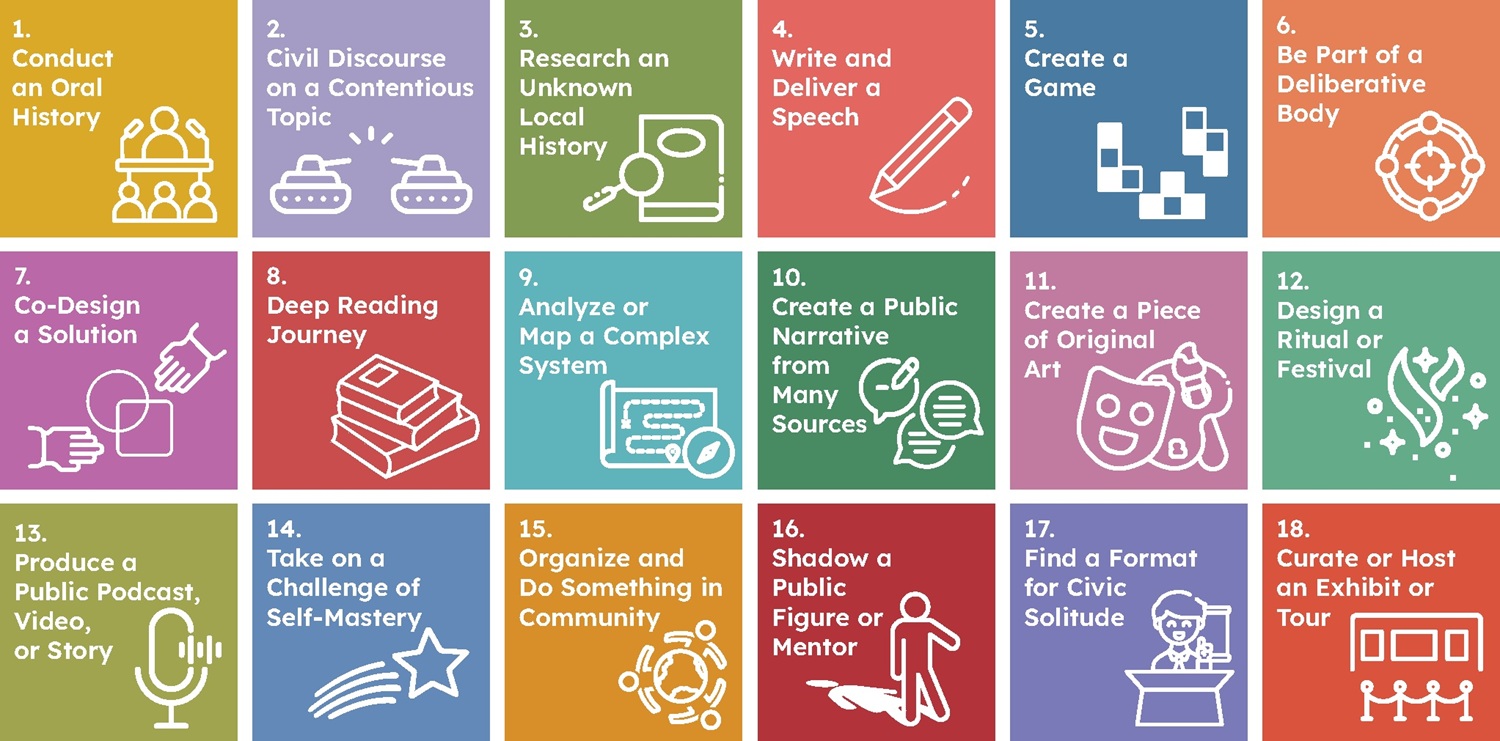
Reason #3: The 18 x 18 Civic Learning Journeys provide practical building blocks to guide adolescents’ civic learning journeys.
“Drawing on decades of work with educators, community members and teens, we have cataloged 18 Civic Learning Journeys that reliably spark [aha] moments. They include community projects that center intergenerational engagement, social innovation, dialogue and history making and include the creation of oral histories, games, op-eds, system maps, curated exhibitions, deliberative decision-making forums and discourse on contentious issues. Some projects trace their roots to traditional societies and the earliest democratic practices; others reflect contemporary innovations. All develop essential aspects of being human that are urgently needed, particularly in the age of AI.”
History Co:Lab
The 18×18 Civic Learning Journeys for Nurturing Adolescent and Community Thriving
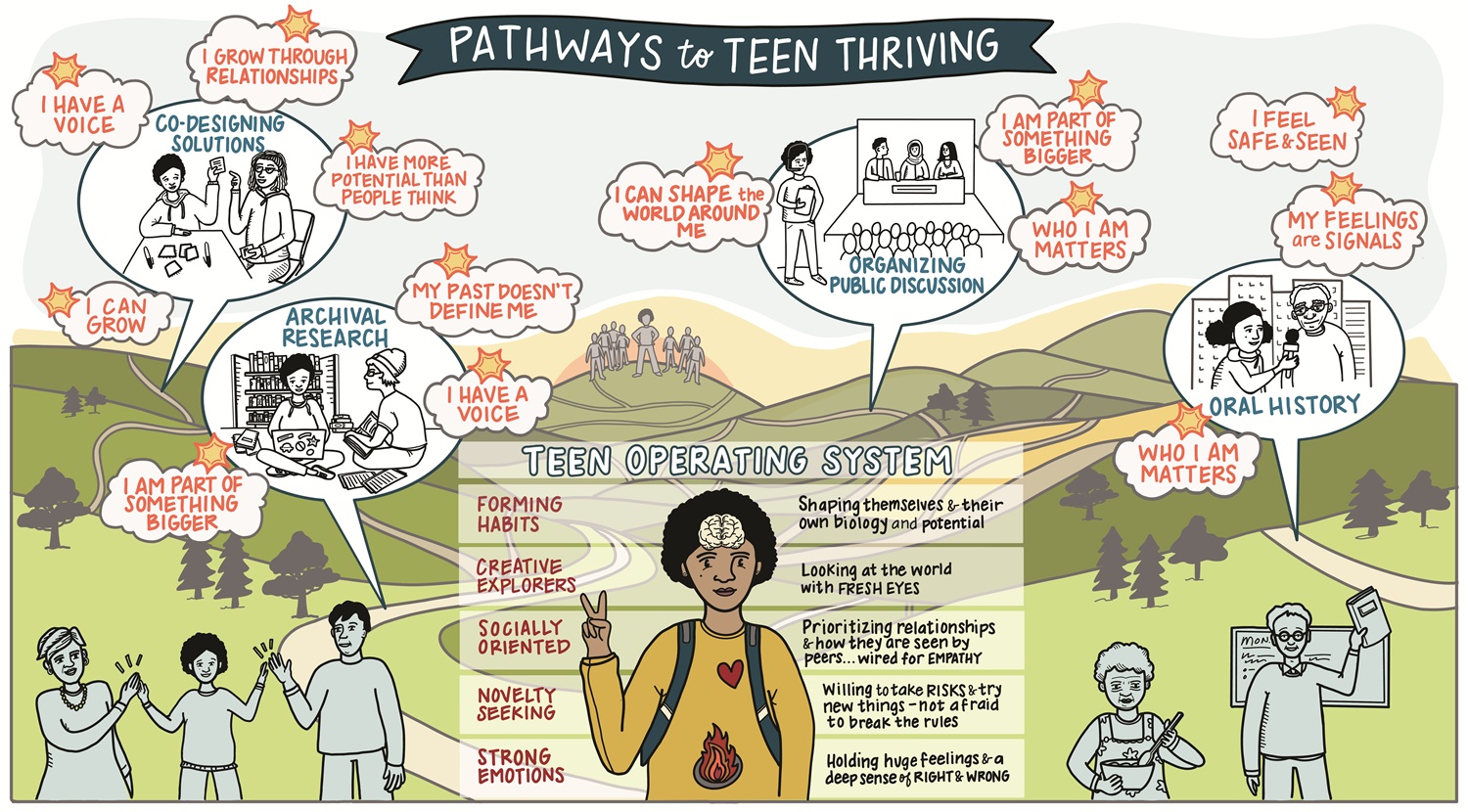
Reason #4: The wonderfully illustrated Learning Journeys Blueprint offers practitioner-focused explanations of why these experiences matter, how they shape thriving and why they prepare young people for civic life, informed by five strands of learning science:
- “The Operating System of Adolescence — the distinctive features of the adolescent brain, including being creative explorers, taking risks and having intense emotions.
- The Ecology of Thriving and Engagement — the role of environments, relationships and communities in shaping durable growth.
- The Science of Civic “Aha” Moments — the breakthrough realizations (“I matter, I can, we can”) that mark turning points in belonging and agency.
- The Humanities as the Gym for Civic Muscles — how history, literature and the arts foster critical thinking, effective communication, collaboration and curiosity.
- Pathways for Civic Thriving — how thriving unfolds in practice when adolescents see themselves as contributors to the common good.”
There is a bonus appendix: A two-page chart that links each of the Civic Learning Journeys to its parallel Greek origin (for historians), to adolescent science evidence (for researchers) and the clusters of specific durable skills they ignite (for practitioners).
Reason #5: The solution proposed underscores the inextricable connection between youth and community thriving.
“Individual and community thriving are inseparable. The history of human societies, across the globe and throughout time, is a rich library of insights on how communities flourish when young people are invited and prepared to contribute to the common good.”
“Teens actually need connection to the community in order to realize I have a voice, who I am matters and I am part of something bigger.
Yet most school pathways focus narrowly on individual success, neglecting civic imagination, cultural stewardship and public problem-solving.”
Reason #6: The Co:Lab team suggests seven concrete actions to align our systems with what science and history already tell us — “thriving teens are the foundation of thriving democracies.” These seven actions are:
- Ensure learning works for the teen brain
- Train adults to show up differently
- Create structures for meaningful participation and co-design
- Illuminate pathways into the public good
- Weave civic ecosystems with shared purpose
- Recenter the humanities
- Equip teens to develop and debate worldviews
Throughout the report, the message that comes through loudly is the importance of trust — trusting in adolescents’ insatiable desire to learn, grow and do good.
Trust sparked a movement in Pakistan called Trust-Based Changemaking, led by another Ashoka alum, Ali Khan. I featured his model in several columns over the past few months, drawn by both the simplicity of his model and the incredible evidence of its success in not only sparking civic agency in youth but in changing the mindsets of educators. I find myself sharing this quote from him frequently:
“Trust young people first, evaluate later.
When you trust young people, they don’t just rise — they soar.
And in doing so, they can change the world.”
Delve further into examples of trust-based changemaking in my previous columns:
The revolutionary speed of trust-based changemaking
Trust-based changemaking may change the world, but can it change institutions?
Trust, time and training: Unlocking the potential of learning ECOsystems
***
In her columns, Karen Pittman is exploring the research behind the statement, “When Youth Thrive, We All Thrive.”